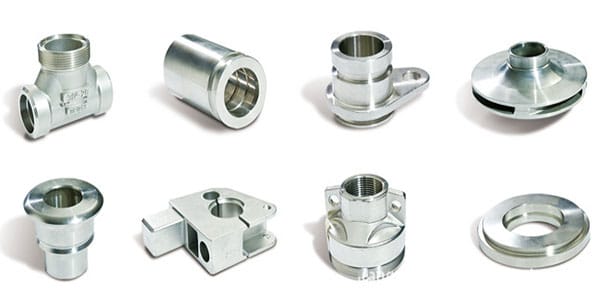

Aluminum die castings are popular in many industries. But to improve their surface quality and properties, Many users choose to invest in aluminum die casting surface treatment. There are many finishing options used in aluminum die casting. This article will discuss the different surface finishing you can use for aluminum die-cast parts.
The aluminum die-casting surface treatment generally includes powder spraying (ie powder spraying), baking paint, oxidation, sandblasting and electroplating. According to the thickness and smoothness of the product surface treatment.
1. Powder coating
The powder coating is sprayed onto the surface of the workpiece by powder spraying equipment (electrostatic spraying machine). Under the action of static electricity, the powder will be uniformly adsorbed on the surface of the workpiece to form a powder coating.
Powder spraying is divided into outdoor powder and indoor powder. The texture can be adjusted to a variety of effects. Such as smooth, sand, and foam.
The powder spraying effect is superior to the spraying process in terms of mechanical strength, adhesion, corrosion resistance, and aging resistance. The cost is also lower than the spraying with the same effect.
1) Function. Provide a protective layer for castings and get a beautiful and smooth surface, and provide good corrosion resistance.
2) Principle. A high-voltage electrostatic field is formed between the spray gun (nozzle) and the coated casting. so that the atomized paint particles are negatively charged in the high-voltage electric field and fly to the positively charged surface of the casting to form a uniform paint film.
3) Requirements for electrostatic spraying work:
①Before starting the spraying or changing the oil, carefully clean the spray gun and agitator. After starting the machine, carefully check whether all the parameters are displayed normally.
②Choose the most appropriate way of hanging the cage according to the shape of the aluminum alloy die-casting parts to ensure that each workpiece can be sprayed with oil.
③ Adjust the pulling speed (workpiece walking speed) as needed.
④ Master the viscosity of the oil, the amount of oil supplied, and the degree of atomization.
⑤ Accurate temperature control.
2. The real baking paint process is to use aluminum alloy phosphating and then spraying. After spraying, baking. This kind of coating is not only anti-corrosion, but also bright and wear-resistant, and it is not easy to fall off.
Surface pretreatment process
1) 1 Degreasing. 2 Water washing. 3 Rust removal.4 Water washing. 5 Table conditioning. 6 Water washing.7 Phosphating.8 Water washing; 9 Water washing; 10 Drying.
2) The purpose of pretreatment is to get a good coating. Because stamping parts will have grease, oxide scale, dust, rust and corrosion on the surface during manufacturing, processing, handling, and storage. If it is not removed, it will directly affect the performance and appearance of the coating film. So, pretreatment plays an extremely important role in the coating process.
3) The meaning of preprocessing:
Pre-coating, coating and drying are the three main processes of the coating process. Among them, pre-coating treatment is the basic process. It has an important impact on the quality of the entire coating, service life, and appearance.
The surface of the workpiece after degreasing, rust removal, phosphating and other processes is clean, uniform and free of grease.
3. Oxidation
The surface oxidation of aluminum alloy die castings is suitable for conductive oxidation. Aluminum or aluminum profiles are suitable for anodizing. Aluminum alloy oxidation color generally has natural color, sky blue.
1) Anodizing is carried out under the condition of high voltage. It is an electrochemical reaction process. Conductive oxidation does not need electricity. And only need to soak in the potion on the line. It is a pure chemical reaction.
2) Anodizing takes a long time. Often tens of minutes. The conductive oxidation only takes a few tens of seconds.
3) The film produced by anodization is several microns to dozens of microns. And hard and wear-resistant. The film formed by conductive oxidation is only about 0.01-0.15 microns. Wear resistance is not very good. But it is both conductive and resistant to atmospheric corrosion. That’s its advantage.
4) The oxide film is inherently non-conductive. But the film generated by conductive oxidation is really thin. So it can conduct electricity.
4. Sandblasting
Spray a layer of fine sand on the surface of aluminum alloy products. Increase the friction coefficient of the contact surface. The reliability of the connection can be enhanced. The sand has different thicknesses and textures.
5. Electroplating
Electroplating is the use of electrolysis to deposit metals or alloys on the surface of the workpiece. The process of forming a uniform, dense and well-bonded metal layer. This is called electroplating.
1) Principle: The metal or alloy is deposited on the surface of the workpiece to form a metal layer by electrolysis. The casting is the cathode and the plated metal is the anode. A simple understanding is a change or combination of physics and chemistry.
2) Application of electroplating process We generally use the following purposes: a. Anti-corrosion b. protective decoration c. wear resistant. Make the aluminum alloy die casting beautiful and improve the density.
3) The most commonly used electroplatings are nickel, tin, copper, silver, and gold. Aluminum alloy die casting.
4) Electroplating should meet the following conditions: good surface quality. There must be no defects such as looseness, cracks, pores, air bubbles, shrinkage holes, cold lines, and pinholes. Otherwise, the surface of the casting will blister after electroplating. The plating layer is detached from the substrate.
Due to the pre-plating treatment, polishing or grinding is required. Easy polishing and uniform shape are taken into account when designing castings. Avoid uneven convex and concave, large planes and sharp edges and corners.
6. Impregnation treatment
In the aluminum alloy die-casting process, defects. Such as pores, shrinkage cavities, and shrinkage porosity are easy to occur. If these tiny holes are connected in the wall thickness direction. When the casting is subjected to air pressure or hydraulic pressure, air leakage, oil leakage and water leakage will occur. The remedy is to use impregnation technology.
1) Principle: Under the conditions of vacuum and pressure, the liquid infiltrant is infiltrated into the tiny holes of the casting. After curing, the hole is blocked to achieve the purpose of sealing.
2) Function: For pressure-bearing castings with micropore defects below 0.5 mm, the pass rate of one-time infiltration is over 95%. The temperature resistance can reach 500~800℃.
3) Method: vacuum impregnation, pressure impregnation, vacuum pressure impregnation.
4) Impregnating agents: silicates, various resins. Organic and inorganic infiltrators.
5) Technological process. Clean the die castings (degreasing, cleaning, drying) → put in the impregnation tank → vacuumize → maintain pressure → inject impregnating liquid → vacuumize again → pressurize, maintain pressure → post-dipping treatment (rejection) drying, washing, drying).
6) Equipment. It consists of a degreasing tank, cleaning tank, drying tank, liquid storage tank, impregnation tank, residual liquid recovery device, curing tank, electric control cabinet, vacuum pump group, and air compressor. The whole process of infiltration process can be automated.
7) Application. Die-casting parts of automobile engines, die-casting parts of plumbing equipment, die-casting parts of the valve body, and die-casting parts of motorcycles.