

Foundry Tips: ASTM Standard, Condition A & Heat Treatment for 17-4PH Precision Castings
Introduction
17-4PH stainless steel is one of the most widely used precipitation-hardening stainless steels in the investment casting industry. Engineers usually choose this material first when components need high strength, good corrosion resistance and stable dimension performance.
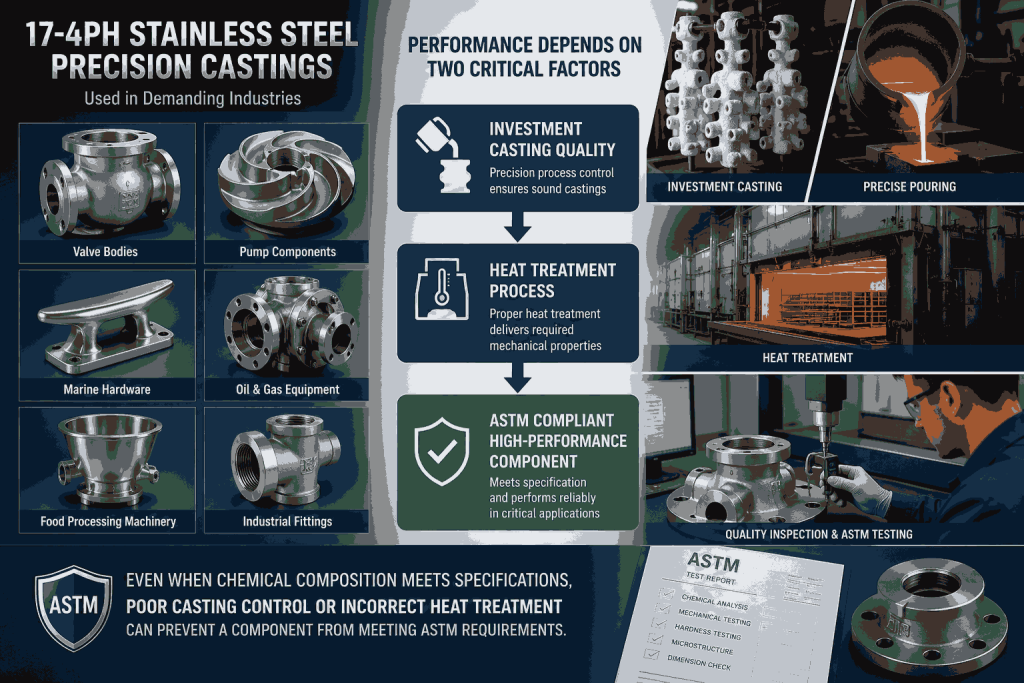
You can find 17-4PH castings in many demanding applications, including valve bodies, pump components, marine hardware, oil and gas equipment, food processing machinery, and industrial fittings.
However, selecting 17-4PH is only the first step. The final performance of a casting depends heavily on two critical factors:
·Investment casting quality
·Heat treatment process
Even when the chemical composition meets specifications, poor casting control or incorrect heat treatment can prevent a component from meeting ASTM requirements.
This guide explains the ASTM standards, production process, heat treatment conditions, and practical foundry solutions that help manufacturers produce high-quality 17-4PH precision castings.
ASTM Standards for 17-4PH Investment Casting
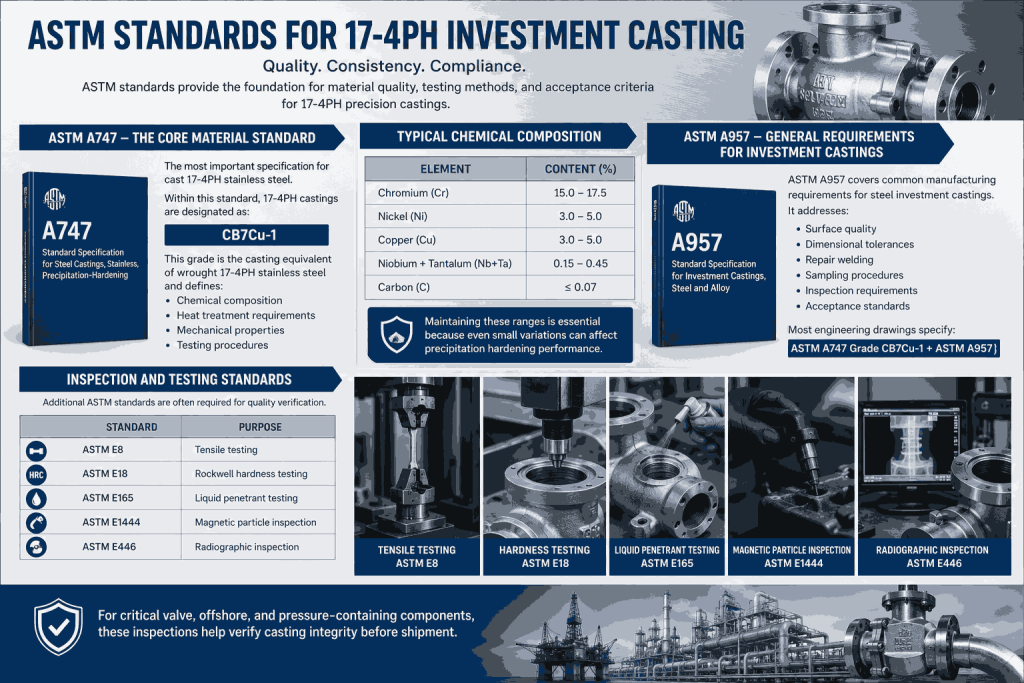
ASTM standards provide the foundation for material quality, testing methods, and acceptance criteria. For 17-4PH precision castings, foundries typically follow several key standards throughout production.
ASTM A747: The Core Material Standard
The most important specification for cast 17-4PH stainless steel is ASTM A747.
Within this standard, 17-4PH castings are designated as:
CB7Cu-1
This grade is the casting equivalent of wrought 17-4PH stainless steel and defines:
·Chemical composition
·Heat treatment requirements
·Mechanical properties
·Testing procedures
Typical Chemical Composition
| Element | Content (%) |
| Chromium | 15.0–17.5 |
| Nickel | 3.0–5.0 |
| Copper | 3.0–5.0 |
| Niobium + Tantalum | 0.15–0.45 |
| Carbon | ≤0.07 |
Maintaining these ranges is essential because even small variations can affect precipitation hardening performance.
ASTM A957: General Requirements for Investment Castings
ASTM A957 covers common manufacturing requirements for steel investment castings.
It addresses:
·Surface quality
·Dimensional tolerances
·Repair welding
·Sampling procedures
·Inspection requirements
·Acceptance standards
Most engineering drawings specify:
ASTM A747 Grade CB7Cu-1 + ASTM A957
Inspection and Testing Standards
Additional ASTM standards are often required for quality verification.
| Standard | Purpose |
| ASTM E8 | Tensile testing |
| ASTM E18 | Rockwell hardness testing |
| ASTM E165 | Liquid penetrant testing |
| ASTM E1444 | Magnetic particle inspection |
| ASTM E446 | Radiographic inspection |
For critical valve, offshore, and pressure-containing components, these inspections help verify casting integrity before shipment.
17-4PH Investment Casting Production Process
Producing high-quality 17-4PH castings requires more than simply pouring molten metal into a mold. Every step affects the final mechanical properties and dimensional accuracy.
At JC CASTING, the production process includes several tightly controlled stages.
Step 1: Wax Pattern Production
The process begins with injection molding wax patterns.
The wax pattern determines:
·Final geometry
·Dimensional accuracy
·Surface finish
Poor wax quality can create defects that remain throughout the entire manufacturing cycle.
Step 2: Shell Building
Workers repeatedly dip wax assemblies into ceramic slurry and refractory sand.
Several ceramic layers are built to form a strong shell capable of withstanding molten stainless steel temperatures.
The shell must provide:
·Sufficient strength
·Uniform thickness
·Good permeability
Step 3: Dewaxing
The wax is removed using steam autoclaves.
This step creates a hollow ceramic mold while minimizing shell cracking.
Step 4: Melting and Pouring
17-4PH stainless steel is melted in medium-frequency induction furnaces.
Strict control of alloy chemistry is essential during melting.
Foundries monitor:
·Chromium content
·Nickel content
·Copper content
·Nb/Cb additions
·Carbon level
The molten metal is then poured into preheated ceramic shells under controlled conditions.
Step 5: Shell Removal and Cut-Off
After solidification, the ceramic shell is removed.
Individual castings are cut from the casting tree and prepared for further processing.
Step 6: Heat Treatment
Heat treatment is one of the most important stages for 17-4PH.
Without proper heat treatment, the alloy cannot achieve its designed strength.
Step 7: Machining and Inspection
Final operations may include:
·CNC machining
·Surface finishing
·NDT inspection
·Mechanical testing
·Dimensional verification
Only after passing inspection can the castings be released for delivery.
Condition A & Other Common Heat Treatment for Cast 17-4PH
Heat treatment gives 17-4PH its unique combination of strength and corrosion resistance.
Different heat treatment conditions create different property profiles.
What Is Condition A?
Condition A is the solution-treated condition.
Typical treatment:
·Heat to approximately 1900°F (1040°C)
·Hold for sufficient time
·Air cool to room temperature
Condition A creates a relatively soft martensitic structure that serves as the starting point for aging treatments.
Characteristics of Condition A
| Property | Condition A |
| Strength | Moderate |
| Hardness | Relatively low |
| Machinability | Good |
| Ductility | High |
Many foundries machine complex parts in Condition A before aging.
H900 Heat Treatment
H900 provides the highest strength level.
Typical process:
·Solution treatment
·Age at 900°F (482°C)
Advantages
·Maximum hardness
·Highest tensile strength
·Excellent wear resistance
Limitations
·Lower toughness
·Reduced ductility
Typical applications include:
·Valve trim
·Aerospace hardware
·High-strength mechanical parts
H1025 Heat Treatment
H1025 offers a balanced combination of strength and toughness.
Many industrial users consider it the most versatile condition.
Advantages
·High strength
·Improved toughness
·Better dimensional stability
Common applications:
·Pumps
·Valves
·Oilfield equipment
·Marine fittings
H1075 Condition
H1075 further improves toughness while maintaining strong mechanical performance.
This condition is often selected when components experience dynamic loading or impact forces.
Heat Treatment Comparison
| Condition | Strength | Toughness | Hardness |
| Condition A | Medium | High | Low |
| H900 | Highest | Lower | Highest |
| H1025 | High | Good | High |
| H1075 | Moderate-High | Better | Moderate |
For many valve and offshore applications, H1025 provides the best overall balance of properties.
Foundry Solutions to Avoid Casting Defects
Even premium alloys can fail if casting defects are not controlled properly.
Experienced foundries focus on prevention rather than correction.
Controlling Shrinkage Porosity
Shrinkage occurs during solidification.
Common solutions include:
·Optimized gating systems
·Proper riser design
·Casting simulation software
·Controlled pouring temperature
These methods help feed liquid metal into critical sections during solidification.
Reducing Gas Porosity
Gas defects often result from:
·Moist shell materials
·Poor melting practices
·Contaminated charge materials
Foundries reduce risk by:
·Strict shell drying control
·Clean raw materials
·Controlled furnace operations
Preventing Hot Cracking
17-4PH can be sensitive to thermal stress.
Effective measures include:
·Uniform wall thickness design
·Controlled cooling rates
·Improved mold design
·Proper gating layout
Maintaining Chemical Consistency
Mechanical properties depend heavily on chemistry control.
Leading foundries use:
·Spectrometer analysis
·Heat-by-heat verification
·Incoming material inspection
·Process documentation
Heat Treatment Validation
Heat treatment should never be treated as a routine step.
Every batch should undergo verification through:
·Hardness testing
·Tensile testing
·Metallographic analysis
·Process records review
This approach helps ensure compliance with ASTM standards and customer specifications.
Why Casting and Heat Treatment Must Work Together
Many buyers focus only on alloy selection when sourcing 17-4PH components.
In reality, alloy chemistry alone cannot guarantee performance.
Three castings made from the same 17-4PH material can produce very different results if:
·Gating design differs
·Solidification control varies
·Heat treatment parameters change
The best results come from a complete manufacturing system where material control, casting expertise, heat treatment, machining, and inspection work together.
JC CASTING Professional Recommendation
When selecting 17-4PH precision castings, engineers should evaluate more than just material certificates.
Ask suppliers about:
·ASTM compliance procedures
·Casting simulation capability
·Heat treatment equipment
·Mechanical testing records
·Experience with valve and marine components
At JC CASTING, we manufacture precision investment castings for valve, pump, marine, food processing, mining, and industrial equipment applications. Our team controls every stage of production—from material melting and shell building to heat treatment and final inspection—to help customers achieve consistent ASTM-compliant quality.
If you are evaluating your 17-4PH precision casting project, JC CASTING’s engineering team can provide you professional material selection suggestion, casting feasibility analysis and production process optimization plan. We help you get more stable, reliable and cost-effective casting solution.