

Introduction: Why Material Selection Matters More Than Most Buyers Think
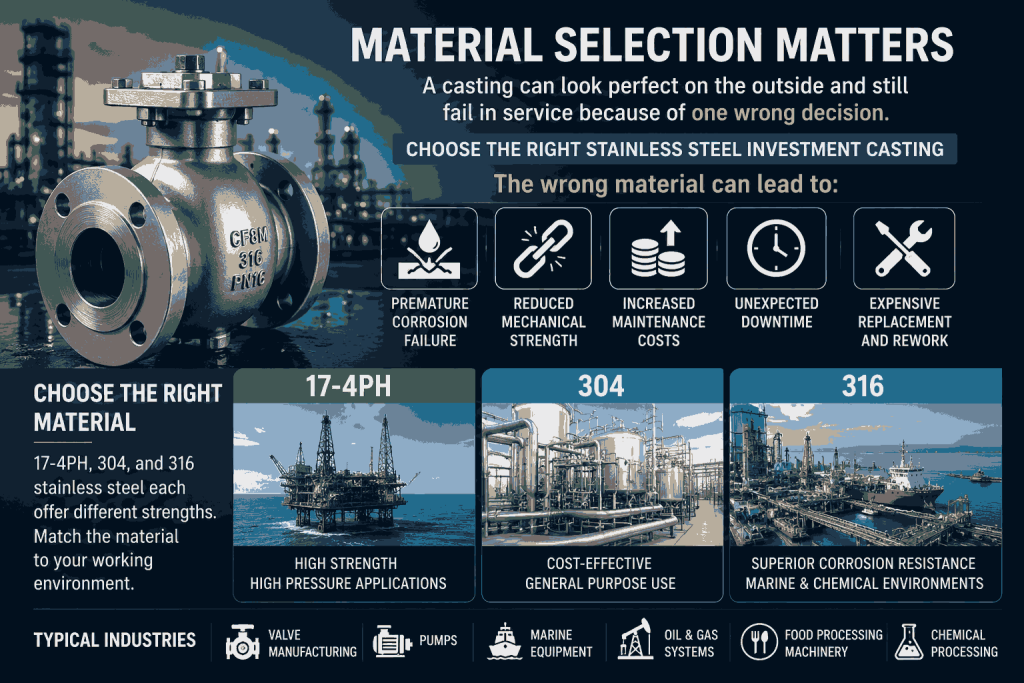
A casting even looks perfect on the outside but still fail in actual operation.This is because of one wrong decision made at the beginning of a project: material selection.
For procurement teams and design engineers, choosing between 17-4PH, 304, and 316 stainless steel investment castings is not simply to compare prices. The wrong material can lead to:
·Premature corrosion failure
·Reduced mechanical strength
·Increased maintenance costs
·Unexpected downtime
·Expensive replacement and rework
In industries such as valve manufacturing, pumps, marine equipment, oil & gas systems, food processing machinery, and chemical processing, the operating environment often determines whether a component lasts for years or fails within months.
This guide compares 17-4PH stainless steel, 304 stainless steel, and 316 stainless steel from an investment casting perspective. We will examine their chemical composition, mechanical properties, corrosion resistance, casting suitability, lifecycle costs, and ideal application scenarios.
By the end, you will have a practical framework for selecting the right stainless steel casting material for your next project.
Quick Overview: 17-4PH vs 304 vs 316 Stainless Steel
| Property | 17-4PH Stainless Steel | 304 Stainless Steel | 316 Stainless Steel |
| Stainless Steel Family | Precipitation Hardening | Austenitic | Austenitic |
| Main Advantage | High Strength | Low Cost & Versatility | Superior Corrosion Resistance |
| Yield Strength | Very High | Moderate | Moderate |
| Hardness | High | Medium | Medium |
| Corrosion Resistance | Good | Good | Excellent |
| Chloride Resistance | Moderate | Moderate | High |
| Heat Treatment | Required | Not Required | Not Required |
| Investment Casting Suitability | Excellent | Excellent | Excellent |
| Typical Industries | Aerospace, Oil & Gas, Valves | Food, General Industry | Marine, Chemical Processing |
| Relative Material Cost | Medium-High | Lowest | Higher |
While all three grades are commonly used in precision casting, their performance characteristics differ significantly.
Chemical Composition Comparison
The alloy chemistry largely determines the behavior of stainless steel in service.
17-4PH Stainless Steel Composition
17-4PH derives its name from approximately:
·17% Chromium
·4% Nickel
It also contains:
·Copper
·Niobium (Columbium)
These elements enable precipitation hardening after heat treatment, giving the material exceptional strength.
Typical Composition (%)
| Element | 17-4PH |
| Chromium | 15.0-17.5 |
| Nickel | 3.0-5.0 |
| Copper | 3.0-5.0 |
| Carbon | ≤0.07 |
| Niobium | 0.15-0.45 |
304 Stainless Steel Composition
304 is the most widely used stainless steel grade worldwide.
Typical Composition (%)
| Element | 304 |
| Chromium | 18-20 |
| Nickel | 8-10.5 |
| Carbon | ≤0.08 |
| Molybdenum | None |
304 offers excellent general corrosion resistance at a relatively economical cost.
316 Stainless Steel Composition
316 builds upon 304 by adding molybdenum.
Typical Composition (%)
| Element | 316 |
| Chromium | 16-18 |
| Nickel | 10-14 |
| Molybdenum | 2-3 |
| Carbon | ≤0.08 |
The molybdenum significantly improves resistance to chloride corrosion and pitting.
Mechanical Properties Comparison
For many valve and pump applications, strength is often the deciding factor.
Mechanical Property Table
| Property | 17-4PH H900 | 304 | 316 |
| Tensile Strength (MPa) | 1310+ | 515 | 515 |
| Yield Strength (MPa) | 1170+ | 205 | 205 |
| Hardness (HRC) | 38-44 | ≤20 | ≤20 |
| Impact Toughness | Good | Excellent | Excellent |
Key Observation
17-4PH can provide over five times the yield strength of 304 or 316.
This allows engineers to:
·Reduce wall thickness
·Lower component weight
·Improve wear resistance
·Increase pressure capability
For high-pressure valves, impellers, actuator parts, and structural components, 17-4PH often becomes the preferred choice.
Corrosion Resistance Comparison
Strength alone does not guarantee long service life.
The operating environment must always be considered.
304 Stainless Steel
304 performs well in:
·Fresh water
·Food processing environments
·Indoor industrial applications
However, it may experience pitting corrosion in chloride-rich environments.
316 Stainless Steel
The added molybdenum improves resistance to:
·Saltwater exposure
·Coastal environments
·Chemical processing media
·Chloride-containing solutions
For marine applications, 316 generally outperforms 304.
17-4PH Stainless Steel
17-4PH provides corrosion resistance comparable to many standard stainless steels while offering much higher strength.
However, in highly aggressive chloride environments, 316 usually remains the safer choice.
Corrosion Resistance Ranking
1.316 Stainless Steel
2.17-4PH Stainless Steel
3.304 Stainless Steel
Investment Casting Performance Comparison
Not every material behaves the same during the investment casting process.
17-4PH Investment Casting
Advantages:
·Excellent dimensional stability
·High post-heat-treatment strength
·Good machinability
·Suitable for precision engineered components
Challenges:
·Requires controlled heat treatment
·More demanding process control
Common cast products include:
·Valve components
·Pump impellers
·Aerospace hardware
·Oilfield equipment
304 Investment Casting
Advantages:
·Easy to cast
·Excellent weldability
·Stable process performance
·Cost-effective production
Common applications:
·Food machinery parts
·General industrial hardware
·Architectural castings
316 Investment Casting
Advantages:
·Outstanding corrosion resistance
·Reliable casting behavior
·Excellent durability in harsh environments
Common applications:
· Marine hardware
· Chemical processing equipment
· Pharmaceutical machinery
· Offshore systems
Which Material Is Best for Valve Castings?

Valve manufacturers often face a balance between strength and corrosion resistance.
Choose 17-4PH When:
High pressure ratings are required
Weight reduction is important
Wear resistance matters
Structural strength is critical
Choose 304 When:
Cost control is the priority
Corrosion conditions are mild
Chlorides are presen
Chemical corrosion is a concern
Which Material Is Best for Pump Components?
Pump systems often combine pressure, abrasion, and corrosion.
Recommended Selection
| Operating Environment | Recommended Material |
| Clean Water Pumps | 304 |
| Industrial Process Pumps | 316 |
| High Pressure Pumps | 17-4PH |
| Offshore Pumps | 316 |
| Wear-Resistant Impellers | 17-4PH |
Raw Material Cost vs Total Lifecycle Cost
Many buyers focus only on material price.
However, the purchase price represents only a portion of total ownership cost.
Relative Material Cost
| Material | Relative Raw Material Cost |
| 304 | Lowest |
| 316 | Medium |
| 17-4PH | Highest |
At first glance, 304 appears to be the most economical option.
However, if corrosion or mechanical failure occurs, replacement costs can quickly exceed initial savings.
Lifecycle Cost Considerations
When evaluating cast components, include:
·Initial purchase cost
·Maintenance cost
·Downtime risk
·Service life
·Replacement frequency
In many high-load applications, 17-4PH delivers the lowest total lifecycle cost because of its durability and strength.
In marine and chemical environments, 316 often achieves the best long-term value due to reduced corrosion-related failures.
Material Selection Guide by Industry
Oil & Gas
Recommended:
·17-4PH
·316
Avoid selecting 304 for aggressive environments.
Marine Industry
Recommended:
·316
Best resistance to saltwater corrosion.
Food Processing Equipment
Recommended:
·304
·316
Both provide excellent hygiene and corrosion performance.
Chemical Processing
Recommended:
·316
Preferred for chloride-containing media.
High-Pressure Valve Manufacturing
Recommended:
·17-4PH
Superior strength and pressure capability.
Why Manufacturing Capability Matters as Much as Material Choice
Even the best alloy can fail if casting quality is inconsistent.
Successful investment casting depends on:
·Wax pattern accuracy
·Shell building control
·Melting process stability
·Heat treatment consistency
·Machining precision
·Inspection standards
Material selection and manufacturing quality must work together to achieve reliable component performance.
JC CASTING’s Investment Casting Advantages for 17-4PH, 304 & 316
At JC CASTING, we help customers select the most suitable stainless steel casting material based on actual service conditions rather than material cost alone.
Our capabilities include:
·Precision investment casting for 17-4PH, 304, and 316 stainless steel
·In-house engineering support
·Heat treatment process control
·CNC machining services
·Dimensional inspection and quality verification
·Small to high-volume production
We support customers across:
·Valve manufacturing
·Pump systems
·Oil & gas equipment
·Marine hardware
·Food machinery
·Industrial machinery
Our engineering team works closely with procurement specialists and designers to balance performance, manufacturability, and long-term cost efficiency.If you are evaluating a new projects for valves, pumps, marines, or industrial casting projects, feel free to contact JC CASTING’s engineering team. We will provide professional material selection advice and custom precision casting solutions tailored to your needs.