
Stainless steel clamp connections are widely used when fast installation, easy maintenance, and reliable sealing are important. When choosing a piping connection method, Stainless Steel Clamp Connections vs. Traditional Connections is an important comparison for engineers and procurement teams. Traditional options include welding, threaded connections, and flange connections.
However, clamp connections are not suitable for every piping system. Their pressure rating, temperature range, pipe size, sealing material, and maintenance requirements must be considered before selection.
This guide compares Stainless Steel Clamp Connections vs. Traditional Connections and explains the key advantages, limitations, costs, and applications of each method.
1. Why Choose Stainless Steel Clamp Connections?
Fast Installation and Lower Labor Time
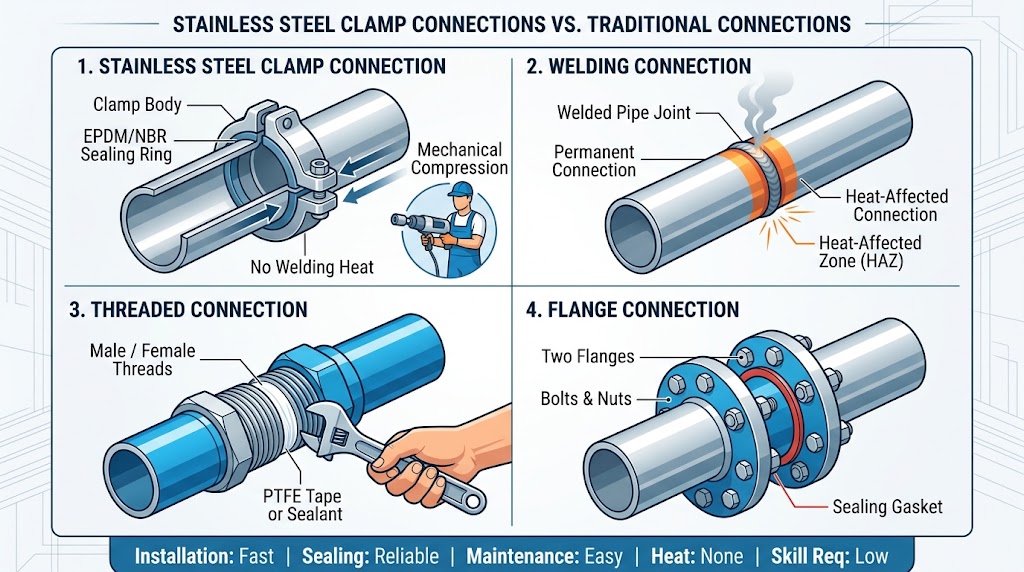
Installation speed is one of the main benefits of stainless steel clamp connections.
Traditional welding requires several steps. The pipe may need preheating, welding, and cooling. Large-diameter pipe welding can take even more time.
Threaded connections also require careful sealing. Workers need to apply PTFE tape or sealant to the threads. Uneven application can slow down installation and may cause leakage.
Flange connections require another set of steps. The pipes must be aligned. Bolt holes must match. Multiple bolts must then be tightened.
A clamp connection uses a simpler process.
First, align the pipe or fitting. Then place the sealing ring in position and install the clamp. Finally, use the proper clamping tool to complete the connection.
For small-diameter pipe fittings, installation can sometimes take less than 1 minute. One worker can usually complete the basic operation.
This makes stainless steel clamp connections useful for projects with many connection points or tight construction schedules.
Simple Operation and Lower Skill Requirements
Traditional connection methods often depend on skilled workers.
Welding requires qualified welders. Poor welding can result in weak welds, incomplete welds, or leakage.
Threaded connections also depend on worker experience. Incorrect sealing tape application can cause leakage. Excessive force can also damage the threads.
Flange connections require proper bolt tightening torque. If the bolts are not tightened evenly, the gasket may not seal correctly.
Stainless steel clamp connections are easier to operate.
Workers do not need advanced welding skills. After basic training, general workers can learn the installation procedure.
This can reduce the dependence on highly skilled labor. It can also help reduce connection problems caused by installation errors.
Reliable Sealing with a Mechanical Compression System
Sealing performance is another important factor when comparing connection methods.
A threaded connection normally uses PTFE tape or sealant to fill the gaps between threads. If the pipe or fitting has poor dimensional accuracy, or the sealing material is applied unevenly, leakage may occur.
Welded joints can also develop leakage. Common causes include weld oxidation, inclusions, and pores.
Flange connections use gaskets. Uneven bolt torque, gasket aging, or poor sealing surface conditions can lead to leakage.
Stainless steel clamp connections use a different sealing principle.
A typical system combines an EPDM or NBR rubber sealing ring with mechanical compression. The clamp applies pressure around the connection. The sealing ring is compressed against the outer surface of the pipe or fitting.
This creates a circular sealing surface. The load is distributed more evenly around the connection.
Some clamp systems also allow limited flexibility. This can help accommodate small amounts of pipe vibration and thermal expansion or contraction.
For example, this feature can be useful around pump outlets and air-conditioning water pipes. It may reduce stress that can occur with fully rigid connections such as welded or flanged joints.
Easier Disassembly and Maintenance
Maintenance is another area where clamp connections have a clear advantage.
A welded joint is normally considered a permanent connection. To remove it, workers usually need to cut the pipe or fitting. The removed component may no longer be reusable.
Threaded connections can become difficult to disassemble after long-term service. Corrosion may cause the threads to seize. Excessive force during removal can damage the pipe or fitting.
Flange connections are removable, but workers must loosen multiple bolts. The gasket may also need to be replaced after disassembly.
A stainless steel clamp connection can be opened much faster.
Workers can release the clamp with the proper tool and separate the connected components. If the clamp and sealing ring are still in good condition, they may be reused.
This is useful for systems that need regular inspection, cleaning, or component replacement.
Examples include food processing pipelines and laboratory fluid systems.
No Welding Heat or Flame
Stainless steel clamp connections also avoid the heat-related problems associated with welding.
Welding produces high temperatures. Local heating can cause oxidation on stainless steel surfaces. Under certain conditions, it may also increase the risk of intergranular corrosion.
Heat can also affect the mechanical properties of the material. Thin-wall stainless steel pipes may deform during welding.
Clamp connections use mechanical compression instead. No welding heat or open flame is required.
This makes them useful for thin-wall stainless steel pipes, food-grade piping, and medical-grade stainless steel systems, where material condition and cleanliness are important.
2. What Are the Limitations of Stainless Steel Clamp Connections?
The benefits of clamp connections do not mean they can replace welding or flanges in all applications.
Pressure, temperature, pipe diameter, sealing material, and service conditions can limit their use.
Limited Pressure and Temperature Capability
Pressure and temperature are two of the most important selection factors.
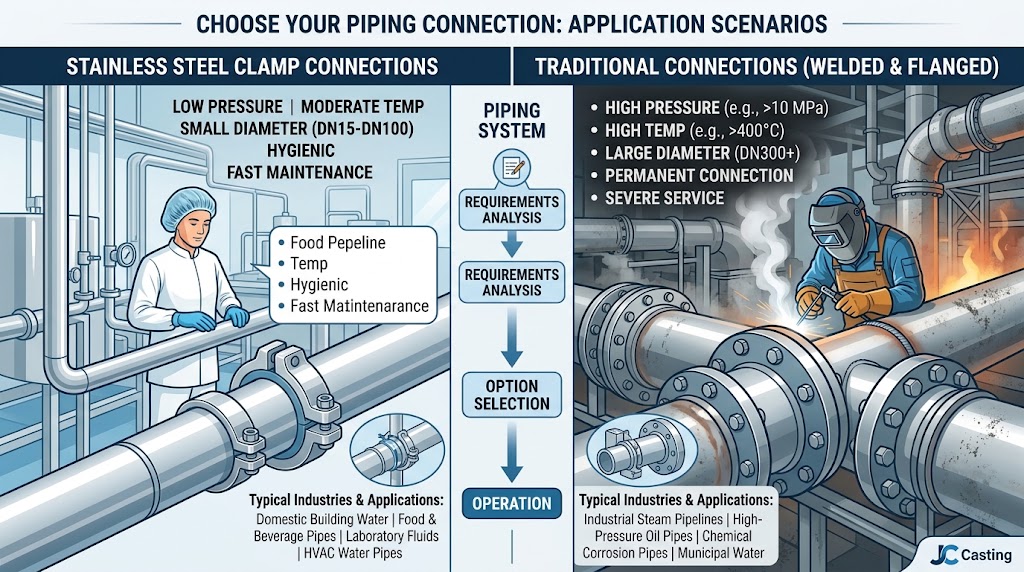
Welded connections and high-pressure flange connections can be designed for demanding service. They can be used in applications with pressures above 10 MPa and temperatures above 400°C, such as industrial steam pipelines and high-pressure oil pipelines.
Standard stainless steel clamp connections normally operate in less severe conditions.
The sealing system depends on a rubber sealing ring. High temperature can accelerate rubber aging and reduce sealing performance.
When the temperature exceeds about 120°C, a special high-temperature sealing ring may be required. This can increase the total cost.
High pressure can also place greater stress on the sealing ring. Excessive compression or pressure can cause deformation and may lead to sealing failure.
For this reason, standard stainless steel clamp connections are generally more suitable for low-pressure and medium-to-low-temperature systems, such as domestic water supply, HVAC water piping, and food and beverage pipelines.
They should not be treated as a direct replacement for welded or high-pressure flange connections in extreme service conditions.
Higher Initial Equipment and Component Cost
Initial cost is another point to consider.
A basic threaded connection can be inexpensive. The main additional materials may only be pipe fittings and PTFE tape or sealant.
Welding also has relatively simple material requirements. The main costs are welding materials and labor. In large projects, labor costs can be spread across many connection points.
A clamp system requires more components.
The system normally includes the stainless steel clamp body and sealing ring. Some applications may require special sealing materials, including imported materials.
A dedicated clamping tool may also be needed. Depending on the application, this can be a manual or electric tool. Tool costs can range from hundreds to thousands of yuan.
Therefore, stainless steel clamp connections may have a higher initial investment than some traditional connection methods.
However, installation speed and easier maintenance can reduce labor time in suitable projects.
Limited Suitability for Large-Diameter Pipes
Pipe diameter also affects connection selection.
Flange connections are widely used for large pipes, including pipes of DN300 and above. They can provide stable mechanical strength when properly designed.
Welding is also suitable for large-diameter pipes. Proper alignment and welding procedures can create a strong permanent joint.
Standard stainless steel clamp connections are more common with small-diameter pipes, typically DN15–DN100.
Large-diameter clamp systems require greater clamping force. As the pipe size increases, the installation tools may become larger and heavier.
Electric or hydraulic tools may be needed.
The clamp itself must also have enough structural strength for long-term operation. Pipe weight, vibration, and external loads can increase the risk of movement or loosening if the connection is not properly designed.
Therefore, large-diameter applications need more careful engineering review before a clamp connection is selected.
Sealing Ring Life Affects Maintenance
The sealing ring is a key component of a clamp connection. It is also a consumable component.
A welded joint does not use a rubber sealing ring. Once a properly executed weld is completed, there is no similar sealing element that needs periodic replacement.
A threaded connection can also operate for a long period when the joint is properly sealed and the service conditions are suitable.
A clamp connection is different.
The rubber sealing ring can age during long-term operation. It may become hard, lose elasticity, or develop cracks.
The working medium can also affect its service life. Strong acids and strong alkalis may attack the sealing material.
A typical sealing ring service life can be around 3–5 years, but actual life depends on temperature, pressure, medium, material, and operating conditions.
Regular inspection is therefore important.
If an aged sealing ring is not replaced in time, leakage may occur. This can increase maintenance work and operating costs.
3. Stainless Steel Clamp Connections vs. Traditional Connections: Which Should You Choose?
There is no single connection method that is best for every piping system.
The right choice depends on the actual working conditions.
Stainless Steel Clamp Connections Are a Good Choice When:
- The system works at low pressure.
- The operating temperature is moderate.
- The pipe diameter is relatively small.
- Fast installation is important.
- Labor time needs to be reduced.
- The system requires regular maintenance.
- Pipe components may need to be removed or replaced.
- No welding heat or open flame is preferred.
Typical applications include:
- Domestic building water supply and drainage
- Residential water pipes
- Air-conditioning water pipes
- Food processing equipment
- Food and beverage pipelines
- Laboratory fluid systems
These applications benefit from fast installation and easy disassembly.
Traditional Connections Are More Suitable When:
- The system operates at high pressure.
- The working temperature is high.
- The pipe diameter is large.
- The service environment is severe.
- A permanent metal connection is required.
- Long-term operation with minimal maintenance is the priority.
Typical applications include:
- Industrial steam pipelines
- High-pressure oil pipelines
- Chemical corrosion-resistant pipelines
- Large-diameter municipal water pipelines
In these conditions, welding or flange connections may provide better overall performance.
4. Final Selection: Compare the Whole System, Not Just the Connection
Stainless steel clamp connections provide several practical benefits. They can shorten installation time, reduce skill requirements, simplify maintenance, and avoid welding heat.
But these advantages come with limits.
Standard clamp systems are generally better for low-pressure, medium-to-low-temperature, small-diameter piping. Their performance also depends strongly on the sealing ring.
For high-pressure, high-temperature, large-diameter, or severe-service applications, welded and flange connections may be a better choice.
Before selecting a connection method, check the pressure, temperature, pipe size, working medium, sealing material, maintenance requirements, and total installation cost.
The connection should be selected based on the complete operating condition, not only the installation cost.
Need Custom Stainless Steel Components?
The connection method is only one part of a reliable piping system. The quality, dimensional accuracy, and material of the connected components are also important.
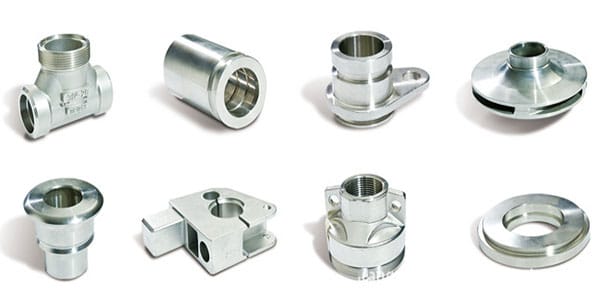
JC Casting supplies custom stainless steel castings and precision-machined components for valves, pumps, piping systems, and industrial equipment. We support different material and production requirements for OEM applications.
If you need custom stainless steel components for your piping or equipment project, contact JC Casting to discuss your drawings, material requirements, and production needs.