
Stainless steel clamps are used in many pipe connection and fixing systems. They are common in construction, HVAC, industrial equipment, transportation, agriculture, municipal projects, and specialized equipment.
Their main advantages are corrosion resistance, high strength, reliable sealing, and easy installation.
The actual application depends on the pipe material, operating environment, pressure, temperature, sealing material, and clamp structure. A clamp used for domestic water may be very different from one used for seawater, pharmaceutical piping, or semiconductor equipment.
This guide explains the main stainless steel clamp applications and the key requirements for each application.
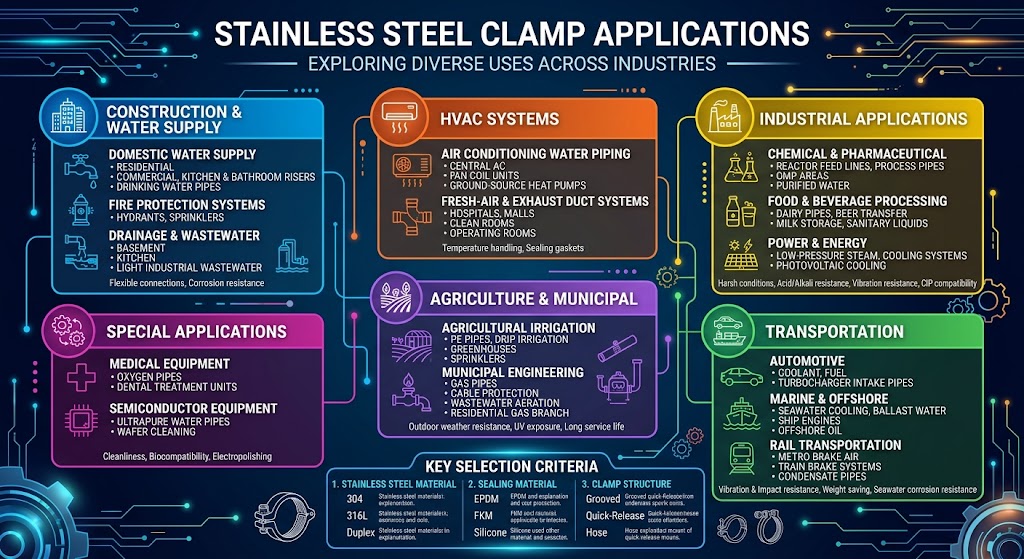
Stainless Steel Clamp Applications in Construction and Water Supply
Building water and drainage systems are one of the most common application areas for stainless steel clamps.
They are mainly used for flexible pipe connections. Thin-wall stainless steel pipes and plastic pipes are common examples.
The connection needs to do more than hold two pipes together. It must also provide reliable sealing and allow some pipe movement.
Domestic Water Supply Systems
Stainless steel clamps can be used with thin-wall stainless steel pipes, PPR pipes, PE pipes, and other water pipes. Thin-wall stainless steel pipes may follow GB/T 19228 requirements.
Typical applications include:
- Residential water supply systems
- Commercial buildings
- Kitchen and bathroom risers
- Drinking water pipes
304 and 316L stainless steel offer good corrosion resistance against tap water. This helps reduce rust and the risk of water quality problems.
A flexible clamp connection can also allow for pipe movement caused by thermal expansion and contraction. This can help reduce leakage risks.
Compared with threaded connections, installation efficiency can increase by more than 30% in suitable applications.
Fire Protection Systems
Fire protection piping has higher requirements for pressure and temperature performance.
Stainless steel clamps can be used with galvanized steel fire pipes and stainless steel fire pipes. They are used in both horizontal and vertical sections of:
- Fire hydrant systems
- Automatic sprinkler systems
- Other fire protection piping
Some products can handle short-term temperatures of 80–120°C. Pressure ratings such as PN16–PN25 are also available for suitable clamp designs.
During a fire, temperature changes can cause pipes to expand. A properly designed clamp connection helps reduce the risk of connection movement or separation.
Grooved-type fire protection clamps are commonly designed with rubber sealing rings. Their sealing performance can meet the requirements of GB 5135.1 for applicable products.
Drainage and Wastewater Systems
Drainage systems can use stainless steel clamps with stainless steel drainage pipes and UPVC wastewater pipes.
Common applications include:
- Basement drainage
- Kitchen wastewater systems
- Light industrial wastewater piping
316L stainless steel can provide good resistance to weakly acidic and alkaline wastewater, including some food service wastewater.
Another advantage is maintenance. A clamp connection can be opened and removed when inspection or repair is required. This makes it more convenient than traditional glued connections, which are generally treated as one-time connections.
Stainless Steel Clamps in HVAC Systems
HVAC systems need connections that can handle changing temperatures while maintaining sealing performance.
Stainless steel clamps can be used in air conditioning water systems and fresh-air or exhaust systems.
The gasket is an important part of the connection. It must match the temperature and medium.
Air Conditioning Water Piping
These systems may include galvanized steel pipes, stainless steel pipes, and other supply and return water pipes.
Stainless steel clamps can be found around:
- Central air conditioning equipment
- Fan coil unit connections
- Ground-source heat pump piping
Some HVAC connections use EPDM sealing rings. Depending on the specific gasket, EPDM can provide a temperature range of about -40°C to 120°C.
This makes it suitable for systems exposed to repeated hot and cold water cycles. For example, air conditioning systems may use about 7°C chilled water in summer and 60°C hot water in winter.
A suitable gasket helps maintain sealing when the media temperature changes.
For R32 and R410A refrigerant systems, the clamp and sealing system must also match the actual refrigerant service conditions.
Fresh-Air and Exhaust Duct Systems
Stainless steel clamps can also be used to connect stainless steel fresh-air ducts and galvanized steel sheet ducts.
Typical locations include:
- Shopping malls
- Hospitals
- Clean areas
- Operating room ventilation systems
A properly designed clamp connection can provide good duct sealing. The original application requirements include an air leakage rate of ≤0.1%.
Stainless steel is also easy to clean. It is less likely to support bacterial growth when the system is properly designed and maintained.
This makes stainless steel useful for clean environments. Hospital applications may also need to meet requirements such as GB 50333-2013, Technical Code for Building of Hospital Clean Operating Department.
Industrial Stainless Steel Clamp Applications
Industrial piping can face much harder working conditions than normal building systems.
The clamp may be exposed to acids, alkalis, high temperature, high pressure, vibration, or repeated cleaning.
For these applications, 316L stainless steel or duplex stainless steel is often selected.
The correct grade depends on the actual operating conditions.
Chemical and Pharmaceutical Piping
Chemical plants may use stainless steel clamps on material transfer pipes. Examples include pipes for hydrochloric acid and dilute sodium hydroxide solutions.
Pharmaceutical plants may use them on process piping for liquids and purified water.
Typical applications include:
- Reactor feed lines
- Pharmaceutical process pipes
- GMP production areas
- Purified water systems
316L stainless steel provides good corrosion resistance. It can be used in acid and alkaline environments within a pH range of 2–12 under suitable conditions.
Pharmaceutical systems also have strict cleaning requirements.
Sanitary quick-release clamps are useful because the connection can be opened easily. Their design can reduce dead spaces and make cleaning easier.
This helps reduce material residue and contamination and supports applications that need to meet GMP requirements.
Food and Beverage Processing
Food and beverage equipment commonly uses food-grade stainless steel pipes for products such as milk, juice, and beer.
Stainless steel clamps can be used on:
- Milk storage tank connections
- Dairy processing pipes
- Beer transfer and outlet pipes
- Other sanitary liquid lines
Surface finish is an important part of sanitary clamp systems.
Some applications require a polished surface with a roughness of Ra ≤0.8 μm. A smooth surface with fewer recesses and dead spaces is easier to clean.
The connection can also work with CIP (Clean-in-Place) systems. Effective CIP cleaning helps remove product residue and reduce microbial growth.
For food-contact applications, the material and product should meet applicable requirements such as GB 4806.9-2016, National Food Safety Standard for Metal Materials and Products.
Power and Energy Equipment
Power and energy equipment can expose clamps to both heat and vibration.
Typical applications include:
- Low-pressure steam pipes
- Auxiliary cooling systems
- Photovoltaic inverter cooling pipes
The original application range includes low-pressure steam service at ≤1.6 MPa.
Some high-temperature clamp designs can withstand short-term temperatures of up to 300°C.
Vibration is another concern. Power plant equipment can produce continuous vibration during operation. A suitable flexible clamp connection can help absorb or reduce vibration transfer.
This can help lower the risk of pipe weld cracking.
Stainless Steel Clamps for Transportation
Transportation equipment creates a different type of challenge.
The connection may experience continuous vibration, impact, temperature changes, rain, seawater, and other outdoor conditions.
Stainless steel clamps are therefore used in automotive, marine, offshore, and rail applications.
Automotive Applications
Automotive systems can use stainless steel clamps on:
- Engine coolant pipes
- Some low-pressure fuel pipes
- Turbocharger intake pipes
- Other engine-related hose connections
They are used in commercial vehicles such as trucks and buses. They are also used in passenger vehicle turbocharger systems.
Weight is one benefit. Compared with cast iron clamps, stainless steel clamps can reduce weight by about 40%.
The locking structure is also important. A toothed locking design can help prevent slipping or loosening under vibration.
Engine compartments can reach high temperatures. Some automotive clamp applications require temperature resistance up to 180°C.
Marine and Offshore Engineering
Marine piping is exposed to seawater and humid marine air.
Typical applications include:
- Seawater cooling pipes
- Ballast water pipes
- Fuel transfer pipes
- Ship engine cooling systems
- Offshore oil transfer pipes
A combination of 316L stainless steel and FKM sealing rings can provide resistance to seawater and marine atmospheric corrosion.
The application may involve seawater with a salinity of about 3.5%.
For marine projects, clamp strength and certification can also be important. Some products may need to meet classification society requirements, including CCS or LR certification.
A reliable connection helps reduce the risk of seawater leakage and the equipment problems that can follow.
Rail Transportation
Rail vehicles are exposed to repeated vibration and impact.
Stainless steel clamps can be used on:
- Metro brake air pipes
- High-speed train brake systems
- HVAC condensate pipes
- Other onboard pipe connections
A train experiences sudden acceleration and braking. The clamp must remain secure during these dynamic loads.
Low-temperature performance is also important in cold regions. Some applications require the clamp to remain stable at around -30°C.
Some clamp designs include anti-loosening marks. Maintenance staff can use these marks to identify possible clamp movement during inspections.
Agriculture and Municipal Stainless Steel Clamp Applications
Outdoor systems need long-term resistance to weather conditions.
Rain, humidity, UV exposure, and other environmental factors can affect pipe connections.
Stainless steel clamps are used in irrigation and municipal systems where outdoor durability is important.
Agricultural Irrigation Systems
Agricultural systems can use stainless steel clamps with:
- PE irrigation pipes
- Stainless steel drip irrigation pipes
- Greenhouse irrigation systems
- Farmland sprinkler systems
304 stainless steel is commonly used for general outdoor corrosion resistance.
The original application requirements specify a service life of ≥10 years for suitable outdoor applications.
Adjustable clamp designs can fit different pipe wall thicknesses. The tightening force can also be adjusted.
This helps keep the connection secure when water pressure changes.
Municipal Engineering
Municipal projects may use clamps for different pipe and utility systems.
Applications include:
- Low-pressure municipal gas pipes
- Street lighting cable protection pipes
- Wastewater treatment aeration pipes
- Residential gas branch pipes
Low-pressure municipal gas applications in the original specification include pressures of ≤0.4 MPa.
Gas-specific clamps can use oil-resistant rubber sealing rings to reduce gas penetration. The applicable system may need to comply with GB 50028-2006, Code for Design of City Gas Engineering.
Wastewater treatment plants can also face corrosive conditions.
316L stainless steel can be used where corrosion from hydrogen sulfide in wastewater is a concern.
Stainless Steel Clamps for Special Applications
Some applications require more than normal corrosion resistance and mechanical strength.
Medical and semiconductor equipment can have strict requirements for cleanliness, surface finish, and material performance.
Medical Equipment
Medical applications include:
- Medical oxygen pipes
- Dental treatment unit water lines
- Other medical equipment connections
Sanitary quick-release clamps are suitable for applications that require easy cleaning.
These clamps are designed without threads in the connection area and can be removed when maintenance is needed.
Some medical applications may also require materials to pass biocompatibility tests such as ISO 10993.
The purpose is to control material safety and avoid unwanted heavy metal release.
Semiconductor Equipment
Semiconductor manufacturing requires very clean fluid systems.
Stainless steel clamps can be used with UPW (Ultrapure Water) pipes in wafer cleaning equipment.
These systems may use 316L electropolished stainless steel.
The required surface roughness can be as low as Ra ≤0.2 μm.
The clamp must also control particle release. This is important because particles can affect high-purity processes.
For applicable ultrapure water piping systems, requirements such as SEMI F57 may apply.
How to Select the Right Stainless Steel Clamp
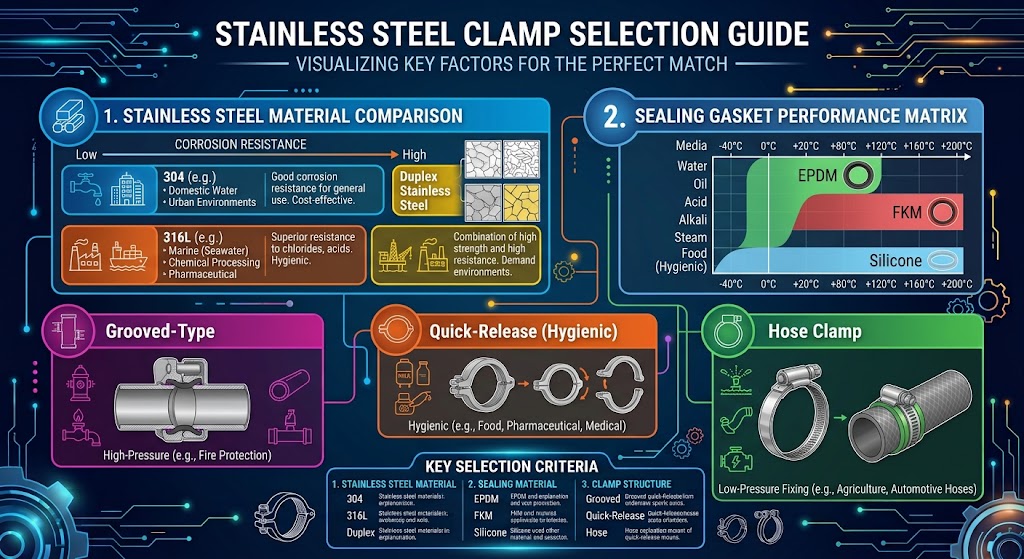
Not every stainless steel clamp is suitable for every application.
The clamp should match the pipe, medium, pressure, temperature, and service environment.
Three factors are especially important.
1. Stainless Steel Material
304 stainless steel is suitable for general corrosion-resistant applications. It can be used for areas such as domestic water supply.
316L stainless steel provides higher corrosion resistance. It is commonly considered for seawater and chemical applications.
Duplex stainless steel combines high strength with high corrosion resistance. It is suitable for demanding environments such as marine engineering.
2. Sealing Material
The sealing ring directly affects the sealing performance of the connection.
EPDM has a temperature range of about -40°C to 120°C and is suitable for water and air applications.
FKM has a temperature range of about -20°C to 200°C and is suitable for oil, acids, and alkalis.
Silicone rubber is commonly used in hygienic applications. Food and medical equipment are typical examples.
The sealing material should match the actual medium and operating temperature.
3. Clamp Structure
Different structures are designed for different connection needs.
Grooved clamps are suitable for high-pressure pipe systems, including fire protection applications.
Quick-release clamps are useful when the connection needs to be opened often. Pharmaceutical systems are one example.
Hose clamps are mainly used for low-pressure fixing applications, such as agricultural irrigation.
The right structure helps the clamp provide stable connection and sealing performance under the required working conditions.
In Short
Stainless steel clamp applications now cover much more than traditional pipe fixing.
They are used in construction, water supply, HVAC, chemical processing, pharmaceutical equipment, food and beverage production, power and energy systems, automotive equipment, marine engineering, rail transportation, agriculture, municipal projects, medical equipment, and semiconductor systems.
The core value of a stainless steel clamp is simple: reliable sealing and good resistance to the working environment.
But the best clamp is not selected by material alone.
The stainless steel grade, sealing material, clamp structure, pressure rating, temperature range, pipe type, and application environment should all be considered together.
If you need help selecting the right stainless steel clamp for your application, please contact us. We can help you evaluate the material, structure, sealing solution, and other requirements based on your specific application.