

Choosing the right stainless steel grade directly impacts product performance, service life, and overall project cost. Among the widely used stainless steel materials for manufacturing , 304 stainless steel and 316 stainless steel are the two most popular options.

Engineers, procurement teams, and product designers often face the same question:
Should I choose 304 or 316 stainless steel?
304 vs 316 Stainless Steel both materials belong to the austenitic stainless steel family and offer excellent corrosion resistance, durability, and fabrication performance. However, important differences in chemical composition and mechanical properties make each grade better suited for specific applications.
In industries such as investment casting, petrochemical processing, food equipment manufacturing, marine engineering, and industrial pumps and valves, selecting the wrong material can lead to premature corrosion, unexpected maintenance costs, or reduced product lifespan.
This guide provides a detailed comparison of 304 and 316 stainless steel, covering strength, corrosion resistance, food-grade suitability, cost considerations, and casting applications.
What Is 304 Stainless Steel?
304 stainless steel is the most widely used stainless steel grade worldwide. It belongs to the 300-series austenitic stainless steels and is often called “18-8 stainless steel” because it typically contains approximately 18% chromium and 8% nickel.
The material offers an excellent balance of:
·Corrosion resistance
·Mechanical strength
·Weldability
·Formability
·Cost efficiency
Typical Chemical Composition of 304 Stainless Steel
| Element | Content (%) |
| Chromium | 18.0–20.0 |
| Nickel | 8.0–10.5 |
| Carbon | ≤0.08 |
| Manganese | ≤2.0 |
| Silicon | ≤1.0 |
| Iron | Balance |
Common Applications
304 stainless steel is commonly used for:
·Food processing equipment
·Commercial kitchen equipment
·Architectural components
·Water treatment equipment
·Pump and valve castings
·Industrial machinery parts
·Investment cast hardware
For many indoor and mildly corrosive environments, 304 stainless steel provides excellent long-term performance at a competitive cost.
What Is 316 Stainless Steel?
316 stainless steel is an upgraded version of 304 stainless steel. The key difference is the addition of molybdenum, typically between 2% and 3%.
This small addition significantly improves resistance to chlorides, saltwater exposure, and aggressive chemical environments.
Typical Chemical Composition of 316 Stainless Steel
| Element | Content (%) |
| Chromium | 16.0–18.0 |
| Nickel | 10.0–14.0 |
| Molybdenum | 2.0–3.0 |
| Carbon | ≤0.08 |
| Iron | Balance |
Why Molybdenum Matters
Molybdenum helps prevent:
·Pitting corrosion
·Crevice corrosion
·Chloride attack
·Seawater corrosion
Because of this, 316 stainless steel is frequently selected for:
·Marine hardware
·Offshore equipment
·Chemical processing systems
·Pharmaceutical equipment
·Food processing plants using chloride cleaners
·Petrochemical facilities
Although more expensive than 304, the increased corrosion resistance often justifies the additional cost in harsh environments.
Which Stainless Steel Is Stronger?
Many buyers assume 316 stainless steel is significantly stronger because it is more expensive. In reality, the strength differences between 304 and 316 are relatively small.
Mechanical Property Comparison
| Property | 304 Stainless Steel | 316 Stainless Steel |
| Tensile Strength | 515 MPa | 515 MPa |
| Yield Strength | 205 MPa | 205 MPa |
| Hardness (Brinell) | 201 HB | 217 HB |
| Elongation | 40% | 40% |
Strength Analysis
Under normal conditions:
·Tensile strength is nearly identical.
·Yield strength is nearly identical.
·Ductility is similar.
·Impact resistance is similar.
Therefore, strength alone is rarely the deciding factor when selecting between 304 and 316.
If a project requires substantially higher strength, engineers often evaluate precipitation-hardening grades such as 17-4 Stainless Steel, which can provide much higher strength levels than either 304 or 316 while maintaining good corrosion resistance.
For structural investment castings, pressure-containing components, and high-load mechanical parts, 17-4PH stainless steel is often considered when standard austenitic grades cannot meet performance requirements.
304 vs 316 Stainless Steel Comparison Table
The following table summarizes the major differences.
| Feature | 304 Stainless Steel | 316 Stainless Steel |
| Chromium Content | Higher | Slightly Lower |
| Nickel Content | Lower | Higher |
| Molybdenum | No | Yes |
| Corrosion Resistance | Excellent | Superior |
| Chloride Resistance | Moderate | Excellent |
| Marine Use | Limited | Recommended |
| Food Grade | Excellent | Excellent |
| Strength | Similar | Similar |
| Weldability | Excellent | Excellent |
| Machinability | Better | Slightly More Difficult |
| Cost | Lower | Higher |
Which Stainless Steel Has Better Corrosion Resistance?
Corrosion resistance is the most important difference between these two materials.
General Industrial Environments
In indoor environments, freshwater systems, and most industrial applications, both materials perform very well.
Examples include:
·Machinery components
·Structural hardware
·General valve castings
·Pump housings
In these situations, 304 stainless steel often provides sufficient protection.
Chloride Environments
Problems begin when chlorides are present.
Examples include:
·Coastal areas
·Seawater
·Road salts
·Chemical plants
·Cleaning chemicals
Chlorides can damage the passive chromium oxide layer that protects stainless steel.
As chloride concentration increases, 304 becomes more susceptible to pitting corrosion.
Because 316 contains molybdenum, it offers significantly better protection.
Marine Applications
For marine equipment, offshore structures, and coastal installations, 316 stainless steel is generally the preferred option.
Typical examples include:
·Boat hardware
·Marine pumps
·Offshore valves
·Seawater filtration systems
Winner for Corrosion Resistance
316 Stainless Steel
The difference becomes increasingly important as environmental conditions become more aggressive.
Food Grade Comparison
Many buyers ask whether 304 or 316 is considered food grade.
The answer is simple:
Both 304 and 316 stainless steel are food-grade materials.
Why 304 Is Popular in Food Equipment
304 is widely used because it:
·Meets food-contact requirements
·Is easy to clean
·Resists common food acids
·Offers excellent value
Applications include:
·Commercial kitchens
·Food storage tanks
·Brewing equipment
·Conveyor systems
Why Some Facilities Choose 316
Food processing environments sometimes use strong sanitizing chemicals that contain chlorides.
Examples include:
·Salt processing
·Seafood processing
·Dairy facilities
·Pharmaceutical production
In these situations, 316 provides additional protection against chemical attack.
Food Grade Recommendation
| Application | Recommended Grade |
| General Food Processing | 304 |
| Commercial Kitchens | 304 |
| Beverage Equipment | 304 |
| Seafood Processing | 316 |
| High-Chloride Cleaning Systems | 316 |
| Pharmaceutical Equipment | 316 |
Cost Comparison
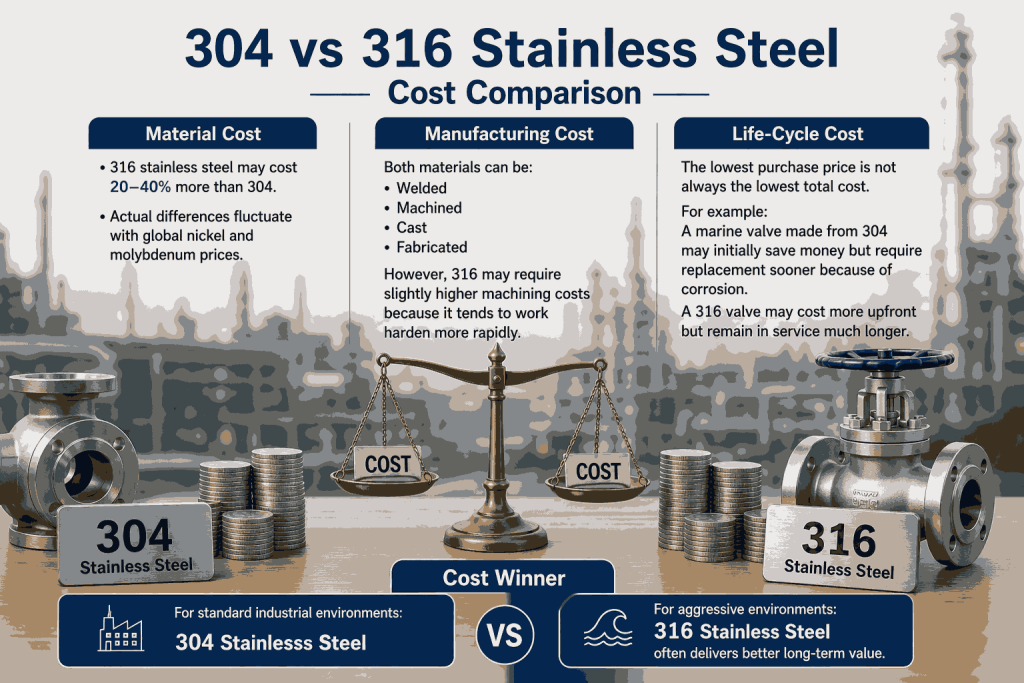
Cost is often one of the most important purchasing considerations.
Material Cost
The higher nickel and molybdenum content in 316 increases raw material costs.
On average:
·316 stainless steel may cost 20–40% more than 304.
·Actual differences fluctuate with global nickel and molybdenum prices.
Manufacturing Cost
Both materials can be:
·Welded
·Machined
·Cast
·Fabricated
However, 316 may require slightly higher machining costs because it tends to work harden more rapidly.
Life-Cycle Cost
The lowest purchase price is not always the lowest total cost.
For example:
A marine valve made from 304 may initially save money but require replacement sooner because of corrosion.
A 316 valve may cost more upfront but remain in service much longer.
Cost Winner
For standard industrial environments:
304 Stainless Steel
For aggressive environments:
316 Stainless Steel often delivers better long-term value.
Which Material Is Best for Investment Castings?
Investment casting manufacturers frequently produce components using both 304 and 316 stainless steel.
The ideal choice depends on service conditions.
When to Choose 304 Stainless Steel Castings
Recommended for:
·Machinery components
·General industrial hardware
·Architectural castings
·Food equipment
·Indoor applications
Advantages:
·Lower cost
·Good machinability
·Excellent appearance
·Reliable corrosion resistance
When to Choose 316 Stainless Steel Castings
Recommended for:
·Marine hardware
·Offshore equipment
·Chemical processing systems
·Petrochemical applications
·Seawater pumps and valves
Advantages:
·Superior corrosion resistance
·Better chloride protection
·Longer service life
What About 17-4 Stainless Steel Castings?
When corrosion resistance alone is not enough, many engineers evaluate 17-4PH stainless steel investment castings.
17-4PH offers:
·Higher strength
·Better wear resistance
·Excellent fatigue performance
·Good corrosion resistance
Typical applications include:
·Pump impellers
·Valve components
·Aerospace hardware
·Oil and gas equipment
Final Selection Guide
Choosing between 304 and 316 stainless steel should be based on the operating environment rather than material cost alone.
Choose 304 stainless steel when:
·Corrosion exposure is moderate
·Budget is a primary concern
·Food-grade performance is required
·Indoor or freshwater conditions are expected
Choose 316 stainless steel when:
·Chlorides are present
·Marine exposure is expected
·Chemical resistance is critical
·Long-term durability outweighs initial cost
Consider 17-4PH stainless steel when:
·High strength is required
·Wear resistance is important
·Structural performance is critical
JC CASTING Professional Material Selection Support
At JC CASTING, we help customers select the most suitable stainless steel grade based on real operating conditions, mechanical requirements, corrosion exposure, and total project cost.
Our engineering team supports a wide range of investment casting materials, including:
·304 Stainless Steel
·316 Stainless Steel
·17-4PH Stainless Steel
·Duplex Stainless Steel 2205
·Super Duplex 2507
·Carbon Steel and Alloy Steel Grades
From material selection and tooling design to casting production, machining, and quality inspection, we work closely with customers to deliver full one-stop manufacturing support.
If you’re reviewing casting material solutions for valves & pumps, offshore equipment, food processing machinery or general industrial components,feel free to reach out to our engineering team!We will offer you the best solution balancing reliable performance and cost efficiency for your project.