

Duplex Stainless Steel 2205 vs 2507: Simple Guide
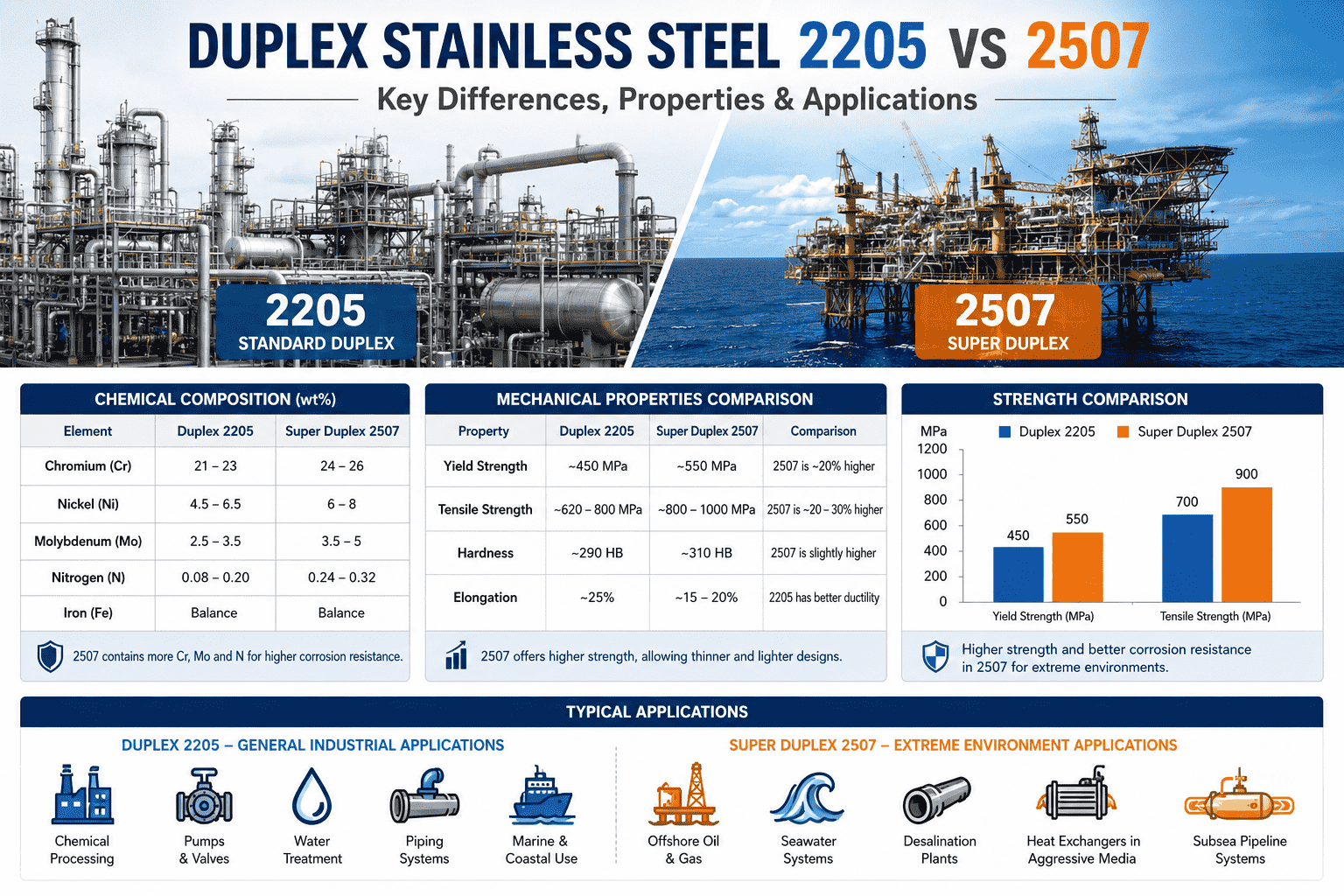
When people talk about duplex stainless steel, two grades often come up first: 2205 and 2507. These materials are widely used in tough industries like chemical plants, oil and gas, and marine engineering. They are popular because they combine high strength and good corrosion resistance.
Even though both belong to the same duplex stainless steel family, they are not the same. They differ in chemical makeup, strength, corrosion resistance, and where they are best used.
Duplex stainless steel gets its name from its two-phase structure. It contains ferrite and austenite. This special mix helps it become stronger and more corrosion-resistant than many normal stainless steels.
Among all duplex grades, 2205 and 2507 are the most commonly used. But they are not interchangeable. This article explains the key differences and helps you choose the right one.
2205 vs 2507: Same Family, Different Performance
Both 2205 and 2507 belong to the duplex stainless steel family. They share the same basic structure: about half ferrite and half austenite. This balance gives them strong performance advantages.
They also share several important features:
1. High Strength
Both materials are much stronger than common stainless steels like 316L. They can handle higher loads and resist fatigue better.
2. Good Resistance to Stress Corrosion Cracking
In salty or chloride-rich environments, both 2205 and 2507 perform much better than 304 and 316 stainless steels. This makes them more reliable in marine and chemical use.
3. Balanced Toughness
They are not as soft or flexible as fully austenitic steels, but they are tougher than ferritic steels. This gives them a good balance of strength and toughness.
4. Weldability
Both materials can be welded. However, they need proper welding control to avoid problems.
Key Difference: 2507 Is a Stronger Version of 2205
You can think of 2507 as an upgraded version of 2205. It contains more alloying elements, which improve strength and corrosion resistance.
Because of this, 2507 works better in very harsh environments, while 2205 is better for general industrial use.
Chemical Composition Difference
The main difference between the two materials comes from three elements:
- Chromium (Cr)
- Molybdenum (Mo)
- Nitrogen (N)
These elements help improve corrosion resistance, especially against pitting and crevice corrosion.
Duplex Stainless Steel Composition & PREN Comparison
| Grade | Chromium (Cr) | Nickel (Ni) | Molybdenum (Mo) | Nitrogen (N) | PREN Value | Corrosion Resistance Level |
| 2205 | ~22% | ~5% | ~3% | ~0.17% | 34–38 | Good (moderate chloride environments) |
| 2507 | ~25% | ~7% | ~4% | ~0.28% | 42–45+ | Excellent (seawater & high-chloride environments) |
Mechanical Strength
2205 has a yield strength of about 450 MPa, which is about twice that of 316L stainless steel.
2507 is stronger. Its yield strength is over 550 MPa. This means engineers can design thinner and lighter parts when using 2507.
However, higher strength also means:
- Higher cost
- More difficult processing
Corrosion Resistance
2205
2205 has strong corrosion resistance. It performs better than 316L in chloride environments. It also has similar pitting resistance to high-grade 904L. It works well in mild to medium corrosion conditions.
2507
2507 has even better corrosion resistance. It can handle:
- Strong chloride environments
- Severe pitting and crevice corrosion
- Harsh seawater and chemical conditions
In some cases, 2507 can replace expensive nickel alloys like Alloy 625 or 254 SMO.
Features of 2205
2205 is a widely used and balanced duplex stainless steel.
Corrosion Resistance
It resists acids, alkalis, and chlorides well. It is especially good in seawater. It also resists stress corrosion cracking and grain boundary corrosion.
Toughness and Ductility
It keeps good flexibility in both low and high temperatures. It can be easily processed using cold forming and welding.
Strength
It is strong enough for most industrial uses, although not as strong as 2507.
Overall Performance
It offers a good balance of strength, corrosion resistance, and cost.
Common Uses
- Chemical equipment
- Marine structures
- Subsea pipelines
- Oil and gas systems
- Food processing equipment
In short, 2205 is a reliable and cost-effective material for many industries.
Features of 2507
2507 is a super duplex stainless steel designed for extreme conditions.
Corrosion Resistance
It has very high resistance to chloride and acid corrosion. It performs extremely well in seawater and harsh chemical environments.
Strength
It has very high yield strength and hardness. It stays stable under high pressure and high temperature.
Toughness
Even though it is very strong, it still keeps enough toughness to avoid brittleness during use and processing.
Applications
- Offshore platforms
- Oil and gas systems
- Marine engineering
- Chemical plants
- Subsea pipelines
Cost
It is more expensive than 2205. But it can save money in the long term because it lasts longer in harsh conditions.
2205 vs 2507Welding and Fabrication Differences
Both 2205 and 2507 can be welded, but 2507 needs more careful control.
For 2507:
- No preheating is usually needed
- Heat input must be controlled (0.2–1.5 kJ/mm)
- Interpass temperature should stay below 150°C
These conditions help keep the correct microstructure and corrosion resistance.
| FABRICATION ISSUE | 2205 | 2507 |
| General weldability | Good | Good, but less forgiving |
| Heat input sensitivity | Moderate | Higher |
| Need for disciplined purge and weld control | Important | More critical |
| Procurement implication | Verify standard fabrication capability | Verify qualified procedures, filler selection, and welding records more carefully |
From a purchasing point of view, buyers should not only check chemical composition. They should also check:
- Welding procedure records (WPS/PQR)
- Material certificates (EN 10204 3.1)
- Inspection reports
This is very important for finished parts like flanges and valves.
2205 is cheaper and easier to find. It is widely available in global markets.
2507 costs more because it contains more nickel and molybdenum. It also needs stricter processing and welding control.
Simple rule:
- Use 2205 for cost-sensitive and moderate environments
- Use 2507 for high-risk and extreme environments
When to Use 2205
Choose 2205 if:
- Salt exposure is moderate
- The environment is not extreme seawater
- You want better performance than 316L but lower cost than super duplex
- Easy manufacturing is important
- Used in general industrial systems
When to Use 2507
Choose 2507 if:
- Direct seawater or brine exposure exists
- Crevice corrosion risk is high
- Failure would cause serious damage or safety issues
- High strength is required
- Long service life is more important than low cost
Engineering Selection Guide (Casting Perspective)
From a casting point of view, choosing between 2205 and 2507 is not just about strength. It is about risk, environment, and production control.
2205 is easier to control in casting. It has a wider process window and lower defect risk. It is often used in pumps, valves, and general industrial castings.
2507 is more sensitive. It is used in extreme environments where corrosion failure is not acceptable. But it requires:
- Strict composition control
- Stable phase balance
- Strong foundry process control
For engineering decisions, buyers should also consider:
- Foundry process capability
- Batch consistency
- Inspection and certification quality
- Welding and post-processing control
In real projects, success depends not only on material grade, but also on how well the material is produced and controlled.