

Complete Material Properties of 17-4PH Stainless Steel | Hardness and Yield Strength Data
Introduction
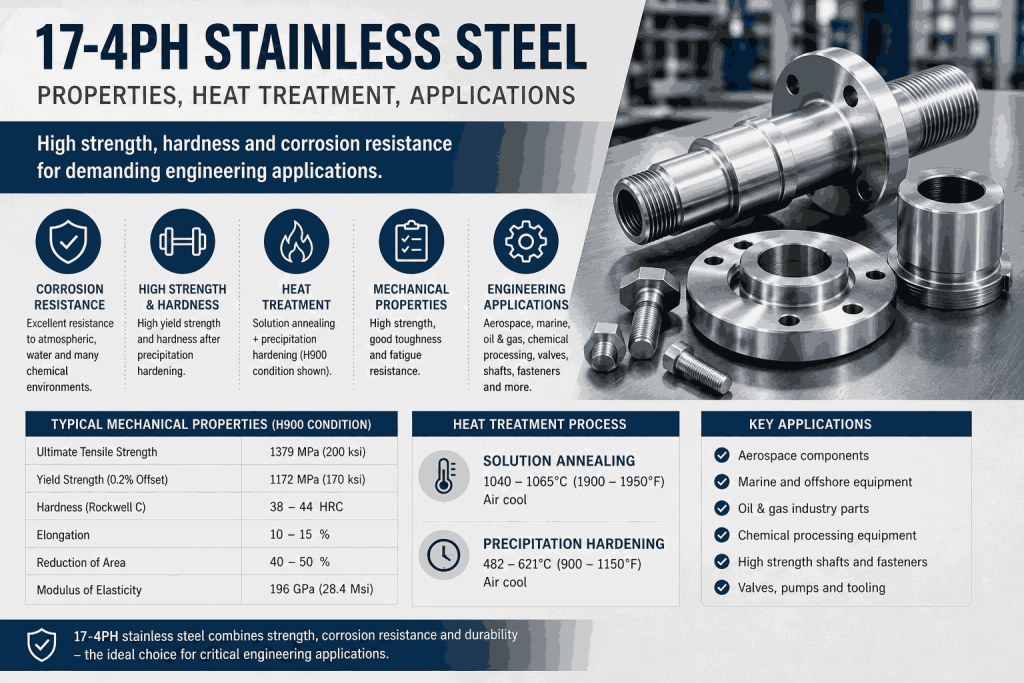
17-4PH stainless steel is a widely favored high-strength stainless steel across modern industries. Most engineers pick this grade for its balanced benefits: outstanding mechanical strength, decent corrosion resistance and stable heat treatment capability.
You can find 17-4PH in industries such as:
·Oil and gas
·Marine engineering
·Aerospace
·Chemical processing
·Food equipment
·Precision casting and valve manufacturing
Unlike standard stainless steels such as 304 or 316, 17-4PH can be strengthened through heat treatment. This ability gives it a unique position between traditional stainless steels and high-performance alloy materials.
This guide explains the complete material properties of 17-4PH stainless steel, including hardness, yield strength, heat treatment, and mechanical data to support engineering and purchasing decisions.
What Is 17-4PH Stainless Steel?
17-4PH stainless steel is a precipitation-hardening martensitic stainless steel.
The name comes from its approximate composition:
·17% Chromium
·4% Nickel
The letters PH stand for Precipitation Hardening.
This alloy gains strength through a controlled aging process rather than simple cold working.
Official material standards include:
| Standard | Grade |
| UNS | S17400 |
| ASTM | A564 / A693 |
| EN | 1.4542 |
17-4PH offers a rare combination:
·High strength
·Good corrosion resistance
·Heat-treatable properties
·Dimensional stability
·Good casting and machining performance
Because of these advantages, 17-4PH remains a common engineering material worldwide.
Chemical Composition of 17-4PH Stainless Steel
The performance of 17-4PH starts with its chemistry.
17-4PH Chemical Composition Table
| Element | Content (%) | Main Function |
| Chromium (Cr) | 15–17.5 | Corrosion resistance |
| Nickel (Ni) | 3–5 | Toughness and structure |
| Copper (Cu) | 3–5 | Precipitation hardening |
| Niobium + Tantalum | 0.15–0.45 | Grain stabilization |
| Carbon (C) | ≤0.07 | Strength balance |
| Manganese (Mn) | ≤1.0 | Deoxidation |
| Silicon (Si) | ≤1.0 | Process support |
| Iron (Fe) | Balance | Base metal |
Two alloying elements play major roles.
Chromium forms a passive layer that protects the surface from corrosion.
Copper drives precipitation hardening and helps build strength during aging treatment.
Why Heat Treatment Matters in 17-4PH
Heat treatment makes 17-4PH different from standard stainless steels.
Grades like 304 and 316 cannot gain major strength through aging. 17-4PH can.
The process normally includes:
Step 1: Solution Treatment
Manufacturers heat the material to around:
1020–1050°C
This step dissolves alloying elements into a uniform structure.
Step 2: Cooling
The material cools to room temperature.
A martensitic structure forms.
Step 3: Aging Treatment
The final aging process controls hardness and strength.
Tiny copper-rich precipitates form inside the metal and strengthen the structure.
This is why the alloy is called precipitation-hardening stainless steel.
17-4PH Heat Treatment Conditions
Different aging temperatures create different property levels.
The most common conditions include:
Heat Treatment Data Table
| Condition | Aging Temp | Main Result |
| H900 | 482°C | Maximum strength |
| H925 | 496°C | High strength |
| H1025 | 552°C | Balanced properties |
| H1075 | 579°C | Improved toughness |
| H1150 | 621°C | Maximum toughness |
The chosen condition changes:
·Hardness
·Yield strength
·Toughness
·Stress resistance
This flexibility makes 17-4PH highly adaptable.
Hardness of 17-4PH Stainless Steel
Hardness is one of the most searched mechanical properties of 17-4PH stainless steel.
Hardness shows how well the material resists:
·Wear
·Surface damage
·Plastic deformation
Different heat-treatment conditions produce different hardness levels.
17-4PH Hardness Data
| Condition | HRC | HB Approx. |
| Solution Treated | 28–32 | 270–310 |
| H900 | 40–44 | 375–430 |
| H1025 | 35–38 | 330–360 |
| H1150 | 28–33 | 280–320 |
Engineering Meaning of Hardness Data
H900 gives the highest hardness.
This improves:
·Wear resistance
·Load capacity
·Strength
However, harder material usually means:
·Lower toughness
·More difficult machining
H1150 creates lower hardness but better ductility and stress resistance.
Engineers often choose hardness based on service conditions.
Yield Strength of 17-4PH Stainless Steel
Yield strength is another critical material property.
Yield strength shows the stress level where permanent deformation begins.
This value matters in:
·Pressure systems
·Shafts
·Structural components
·Valve and pump hardware
17-4PH Yield Strength Data
| Condition | Yield Strength (MPa) |
| Solution Treated | ~620 |
| H900 | 1000–1170 |
| H1025 | 930–1070 |
| H1150 | 720–860 |
These values exceed most common stainless steels.
For comparison:
| Material | Yield Strength |
| 304 | ~215 MPa |
| 316 | ~290 MPa |
| 17-4PH H900 | >1000 MPa |
This large strength advantage allows engineers to:
·Reduce wall thickness
·Lower equipment weight
·Increase load-bearing capability
Tensile Strength and Mechanical Properties
While yield strength measures deformation resistance, tensile strength measures maximum load before fracture.
17-4PH performs extremely well in this area.
17-4PH Mechanical Properties Table
| Property | H900 | H1025 | H1150 |
| Yield Strength (MPa) | 1000–1170 | 930–1070 | 720–860 |
| Tensile Strength (MPa) | 1310–1450 | 1070–1240 | 930–1070 |
| Elongation (%) | 8–10 | 10–13 | 15–18 |
| Hardness (HRC) | 40–44 | 35–38 | 28–33 |
These numbers show an important trade-off.
Lower aging temperatures create:
·Higher strength
·Higher hardness
Higher aging temperatures improve:
·Toughness
·Ductility
·Stress relief
Engineers must balance these factors.
Corrosion Resistance of 17-4PH Stainless Steel
17-4PH provides good corrosion resistance.
It performs better than:
·410 stainless steel
·420 stainless steel
·Many hardened carbon steels
Typical service environments include:
·Industrial atmospheres
·Fresh water
·Food processing
·Mild chemicals
·Moderate marine conditions
However, corrosion performance has limits.
17-4PH does not match:
·316 in severe chlorides
·Duplex stainless steels in seawater
·Nickel alloys in harsh chemicals
Pitting and crevice corrosion may occur under aggressive chloride exposure.
Material selection must consider real environments.
Temperature Resistance
17-4PH handles moderate temperature service well.
Typical operating range:
Up to approximately 300°C
At higher temperatures:
·Strength decreases
·Aging effects may change
·Long-term stability can drop
Cryogenic toughness also remains lower than fully austenitic stainless steels.
This limits use in extreme temperature applications.
Machining Performance of 17-4PH
Machining performance depends heavily on heat-treatment condition.
Solution-Treated Condition
Machining is relatively easy.
Advantages include:
·Lower hardness
·Reduced tool wear
·Better chip formation
Aged Conditions
H900 machining becomes more difficult because hardness rises sharply.
Recommended practices include:
·Sharp carbide tools
·Moderate cutting speed
·Adequate coolant
·Controlled feed rate
Good planning reduces machining cost.
Welding and Fabrication Performance
17-4PH supports several welding methods:
·TIG
·MIG
·Resistance welding
However, welding requires careful control.
Improper welding may cause:
·Property loss
·Distortion
·Reduced corrosion resistance
Post-weld aging treatment often restores performance.
This becomes especially important for:
·Pressure components
·Precision assemblies
·Safety-related parts
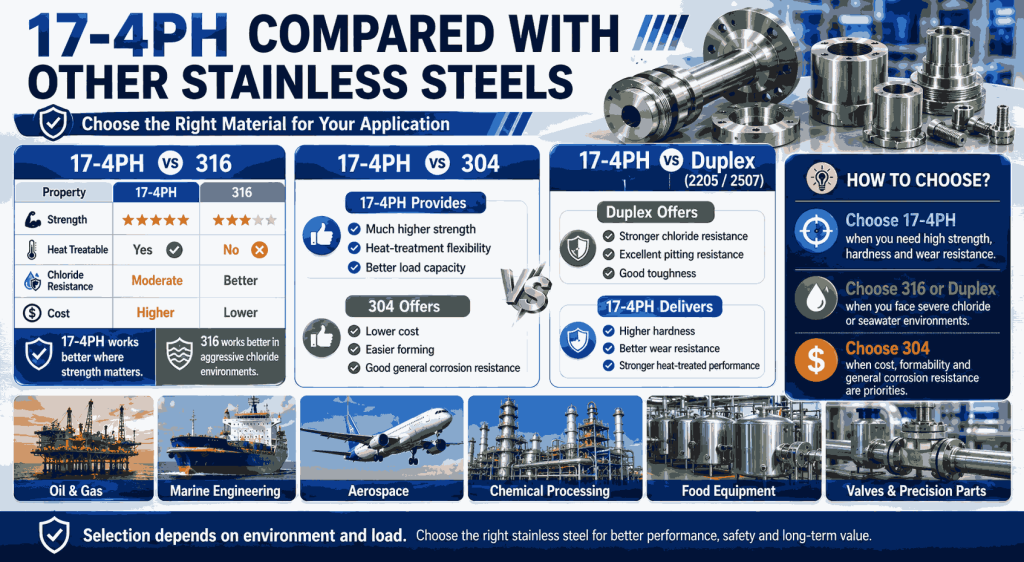
17-4PH Compared with Other Stainless Steels
Material selection becomes easier when engineers compare options.
17-4PH vs 316 Stainless Steel
| Property | 17-4PH | 316 |
| Strength | Very High | Moderate |
| Heat Treatable | Yes | No |
| Chloride Resistance | Moderate | Better |
| Cost | Higher | Lower |
316 works better in aggressive chloride environments.
17-4PH works better where strength matters.
17-4PH vs 304 Stainless Steel
304 remains a general-purpose stainless steel.
17-4PH provides:
·Much higher strength
·Heat-treatment flexibility
·Better load capacity
304 offers:
·Lower cost
·Easier forming
·Good general corrosion resistance
17-4PH vs Duplex Stainless Steel
Duplex grades such as:
·2205
·2507
offer stronger chloride resistance.
However, 17-4PH usually delivers:
·Higher hardness
·Better wear resistance
·Stronger heat-treated performance
Selection depends on environment and load.
Typical Applications of 17-4PH Stainless Steel
The material appears in many industrial systems.
Oil and Gas
Used for:
·Valve trim
·Pump shafts
·Flow control parts
Marine Industry
Applied in:
·Hardware
·Shafting
·Mechanical components
Aerospace
Used in:
·Structural brackets
·Fasteners
·Landing support hardware
Chemical Processing
Used in:
·Pumps
·Pressure parts
·Process fittings
Precision Casting
17-4PH is highly popular in:
·Investment cast valves
·Pump bodies
·Complex cast stainless components
Its strength and heat-treatment flexibility support precision casting.
How to Select the Right 17-4PH Condition
No single heat-treatment condition fits all projects.
A simple selection guide helps.
Choose H900 When:
·Maximum strength matters
·Wear resistance is critical
·Toughness demand is lower
Choose H1025 When:
·Balanced performance matters
·Moderate toughness is needed
·General engineering service applies
Choose H1150 When:
·Toughness is priority
·Stress corrosion concerns exist
·Dimensional stability matters
The correct condition depends on real service conditions.
JC CASTING Professional Material Selection Guidance
At JC CASTING, we believe successful stainless steel components start with the right engineering decisions.
17-4PH stainless steel offers excellent performance, but achieving stable results requires control of:
·Material chemistry
·Heat treatment
·Casting process stability
·Machining and inspection quality
Our engineering team supports customers with:
·17-4PH material selection advice
·Precision investment casting development
·Heat-treatment coordination
·DFM and manufacturability review
·Prototype and volume production support
No matter you’re producing high-strength valves, pump parts, marine fittings or intricate precision castings, JC CASTING matches proper material properties with practical production capacity to guarantee long-term part reliability.