
Stainless steel clamp connections are widely used where a pipe joint must be clean, corrosion-resistant, reliable, and easy to service.
They are especially useful when the piping system needs frequent inspection, cleaning, sterilization, or component replacement. They also work well where welding is not the best installation method.
In general, stainless steel clamp connections are most suitable for low-pressure and medium-temperature systems with special hygiene, cleanliness, maintenance, or flexibility requirements.
However, they are not suitable for every application. Pressure, temperature, chemical exposure, pipe material, and seal material must be checked before selection.
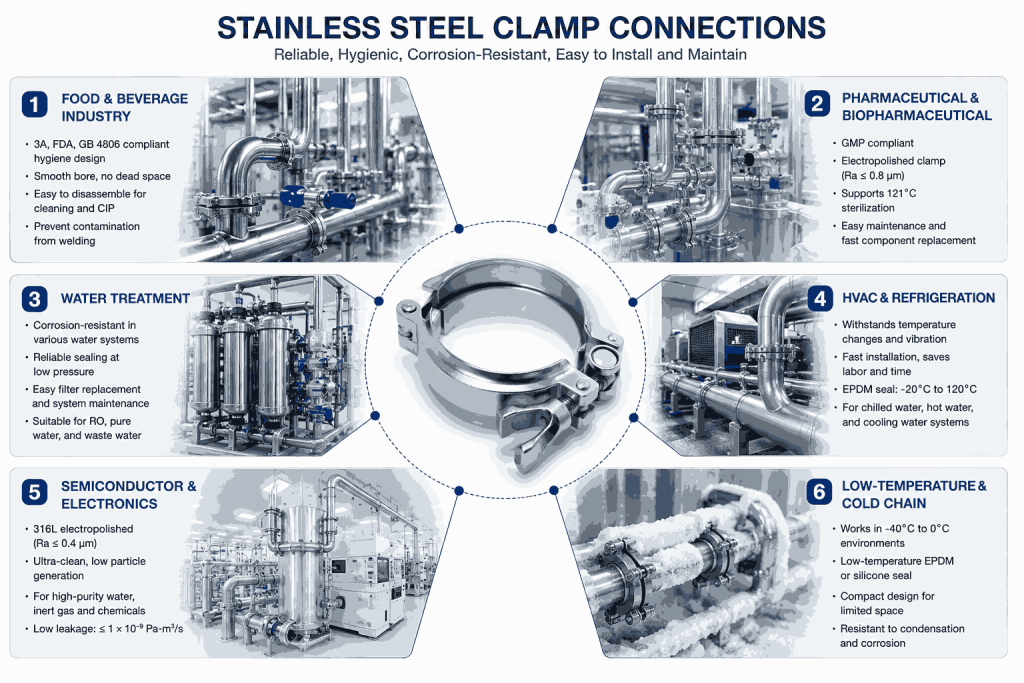
1. Food, Beverage, and Dairy Processing
Food and beverage piping has strict requirements for hygiene and contamination control. The connection is also often opened for cleaning and maintenance.
Main Requirements
Typical food processing systems need:
- High hygiene standards, such as 3-A, FDA, and GB 4806 requirements.
- Smooth internal pipe surfaces.
- Few or no dead areas where product can remain.
- Frequent cleaning and sanitizing.
- CIP (Clean-in-Place) cleaning for many production lines.
- Low risk of contamination from welding or other hot work.
Why Stainless Steel Clamp Connections Work Well
A sanitary clamp can be made from food-grade 304 or 316L stainless steel. It can also be combined with food-grade seals such as EPDM or silicone rubber.
The clamp creates a controlled sealing area around the pipe joint. With the correct sanitary design, it helps reduce product buildup and microbial growth.
Another advantage is fast disassembly.
Operators can remove the connection without cutting the pipe. This makes it easier to clean pipe interiors and replace components such as filters and flow meters.
This is useful when a production line changes products often.
Clamp installation also does not require high heat or an open flame. Therefore, it avoids the heat effects associated with welding. This can reduce the risk of oxidation and welding residue entering the product line.
Common Applications
Stainless steel clamp connections are commonly considered for:
- Fresh milk, yogurt, and cheese processing lines.
- Fruit juice, carbonated beverage, and purified water lines.
- Food processing equipment.
- Sauce, edible oil, and baking ingredient transfer systems.
2. Pharmaceutical and Biopharmaceutical Systems
Pharmaceutical piping has even stricter cleanliness requirements. A connection must support cleaning, sterilization, and contamination control.
It may also need to handle sensitive products such as injectable solutions, vaccines, antibodies, and biological materials.
Main Requirements
Typical requirements include:
- GMP compliance.
- Easy cleaning and sterilization.
- Minimal dead areas.
- Reliable sealing.
- Low risk of cross-contamination.
- Fast replacement of piping components.
- Support for sterile process validation.
How Clamp Connections Meet These Needs
For pharmaceutical applications, the clamp should be selected as a complete hygienic system.
High-cleanliness stainless steel clamps can use electropolished surfaces with Ra ≤ 0.8 μm.
The seal must also match the process. Options can include FKM and platinum-cured silicone for suitable applications.
When the correct seal and clamp are selected, the connection can support high-temperature sterilization, including 121°C moist heat sterilization.
The mechanical connection also avoids welding during installation.
This reduces the risk of welding residue and heat-related surface problems. It is important where pipe cleanliness and product purity are critical.
Maintenance is another key benefit.
A clamp can be opened without cutting the pipe. Operators can replace sterile filters or rebuild a pipe section more quickly. This can reduce production downtime and make maintenance easier.
Common Applications
Typical applications include:
- Pharmaceutical production lines.
- Injectable and oral drug solution piping.
- Vaccine and antibody production systems.
- Biopharmaceutical fermentation lines.
- Cleanroom pure-water and disinfectant piping.
3. Water Treatment Systems
Water treatment systems may not require the same hygiene level as pharmaceutical systems. However, corrosion resistance and long-term sealing are still important.
The pipe may be exposed to chlorinated water, softened water, purified water, or industrial process water for long periods.
Main Requirements
Water treatment piping may need to provide:
- Resistance to long-term water exposure.
- Protection against corrosion.
- Reliable sealing at low pressure.
- Easy access for filter replacement.
- Simple pipe flushing and maintenance.
Advantages of Stainless Steel Clamp Connections
304 and 316L stainless steel provide good corrosion resistance for many water treatment environments.
Compared with galvanized pipe or carbon steel flange systems, stainless steel can offer better corrosion resistance in suitable water conditions.
The connection also avoids the corrosion products that can develop around poorly protected carbon steel components.
For sealing, EPDM is a common option for water service when its temperature and chemical limits match the application.
Clamp connections can also be adapted to different cleanliness requirements.
Standard finishes may be suitable for general water systems. Higher-cleanliness or polished clamps can be selected for RO and high-purity water systems.
Common Applications
They may be used in:
- Residential secondary water supply systems.
- Drinking water piping.
- Industrial RO systems.
- High-purity water systems.
- Electronic manufacturing water systems.
- Filters and ultrafiltration equipment.
- Water treatment equipment inlet and outlet connections.
4. HVAC and Refrigeration Systems
HVAC piping often experiences temperature changes and small amounts of vibration.
For example, a water pump may create vibration when it starts or stops. Pipe dimensions may also change as water temperature changes.
This makes connection design important.
Main Requirements
HVAC and refrigeration piping commonly requires:
- Resistance to small pipe movement.
- Reliable sealing during thermal cycling.
- Resistance to water-related corrosion.
- Fast installation.
- Easy maintenance.
- Suitable performance for chilled and hot water.
Typical media include chilled water, hot water, and cooling water.
Common operating temperatures may range from about -10°C to 95°C, depending on the system.
Why Clamp Connections Are Useful
The circular sealing structure provides a degree of flexibility.
It can accommodate small amounts of pipe movement caused by thermal expansion and contraction. It can also help reduce the direct transfer of pump vibration into the pipe joint.
This does not mean a clamp connection replaces a dedicated expansion joint. Its movement capability is limited and must be considered in the system design.
Installation speed is another benefit.
Unlike a flange, a clamp does not require several bolt holes to be aligned and multiple bolts to be tightened. This can save installation time on large commercial HVAC projects.
For example, the connection method can be useful in shopping malls, office buildings, and other large facilities with extensive piping networks.
EPDM seals are commonly used in HVAC water applications. Depending on the exact seal grade, EPDM can typically cover about -20°C to 120°C.
This range covers many common HVAC conditions, including:
- Chilled water at about 5°C to 15°C.
- Hot water at about 40°C to 60°C.
The actual seal temperature rating should always be checked before use.
Common Applications
- Central air-conditioning water lines.
- Fan coil unit piping.
- Chiller supply and return lines.
- Low-temperature hot-water heating systems.
- Floor heating manifold connections.
- Cold-storage and refrigeration water systems.
For very low-temperature service, a suitable low-temperature seal should be selected.
5. Semiconductor and Electronics Manufacturing
Semiconductor production has very strict requirements for cleanliness.
Even small amounts of particles can affect sensitive manufacturing processes.
Piping systems may also transport high-purity water, inert gases, or aggressive chemicals.
Main Requirements
Typical requirements include:
- Ultra-clean piping.
- Very low particle generation.
- Reliable gas and liquid sealing.
- High corrosion resistance.
- Low contamination risk.
- Controlled surface finish.
- Suitable materials for process chemicals.
Some cleanrooms may operate at Class 100 or Class 1,000 cleanliness levels.
Stainless Steel Clamp Connection Features
For high-purity applications, 316L stainless steel clamps can be supplied with electropolished surfaces.
For example, a surface finish of Ra ≤ 0.4 μm may be used for suitable high-cleanliness applications.
A smoother surface can reduce particle attachment.
Mechanical clamping also avoids cutting and welding during final connection assembly. This helps reduce the generation of metal dust and welding-related residue.
Seal selection becomes critical when chemicals are involved.
Depending on the chemical, temperature, and pressure, FKM or FFKM seals may be considered.
The seal must be checked against the actual chemical compatibility requirements. No single seal material is suitable for every chemical.
For inert gas systems, a properly designed clamp and seal can provide very low leakage performance.
A leakage rate of ≤1 × 10⁻⁹ Pa·m³/s may be required in some high-purity applications.
The actual leakage specification should be confirmed according to the system design and testing standard.
Common Applications
- Semiconductor wafer fabs.
- High-purity water piping.
- Nitrogen and argon gas lines.
- Electronics manufacturing.
- PCB cleaning fluid systems.
- Battery electrolyte and process chemical lines.
6. Low-Temperature and Cold-Chain Applications
Low-temperature environments create a different sealing problem.
The stainless steel itself may perform well, but the seal can become hard or lose elasticity if the wrong material is selected.
This is why both the clamp and gasket need to be evaluated.
Main Requirements
Typical low-temperature applications may involve:
- Temperatures from about -40°C to 0°C.
- Repeated temperature changes.
- Risk of seal hardening.
- Limited maintenance space.
- Condensation and moisture.
- Frequent equipment servicing.
Why Stainless Steel Clamp Connections Can Be Used
304 and 316 stainless steel maintain good toughness at low temperatures.
This makes them suitable for many low-temperature applications without the low-temperature brittleness concerns associated with some other materials.
However, the seal must also be designed for the temperature.
Low-temperature EPDM or silicone rubber can be selected for suitable applications. The correct grade can maintain better flexibility at temperatures down to around -40°C, depending on the material specification.
Clamp connections are also compact.
They can be useful in refrigeration equipment where working space is limited. Maintenance can be easier than with larger flange connections.
Condensation is another concern.
Stainless steel offers good resistance to corrosion from moisture and condensation. This can help extend the service life of piping compared with carbon steel in suitable environments.
Common Applications
- Refrigeration lines in cold-chain equipment.
- Refrigerated trucks.
- Cold-storage facilities.
- Evaporator connection piping.
- Low-temperature laboratory equipment.
- Cooling-water lines for low-temperature reactors.
Where Should Stainless Steel Clamp Connections Be Used?
The common feature of these applications is not simply the use of stainless steel.
The real reason is the combination of corrosion resistance, reliable sealing, easy disassembly, hygiene, cleanliness, and limited movement capability.
They are especially useful when a piping system needs regular cleaning or maintenance and when welding is not the preferred connection method.
Typical operating conditions are:
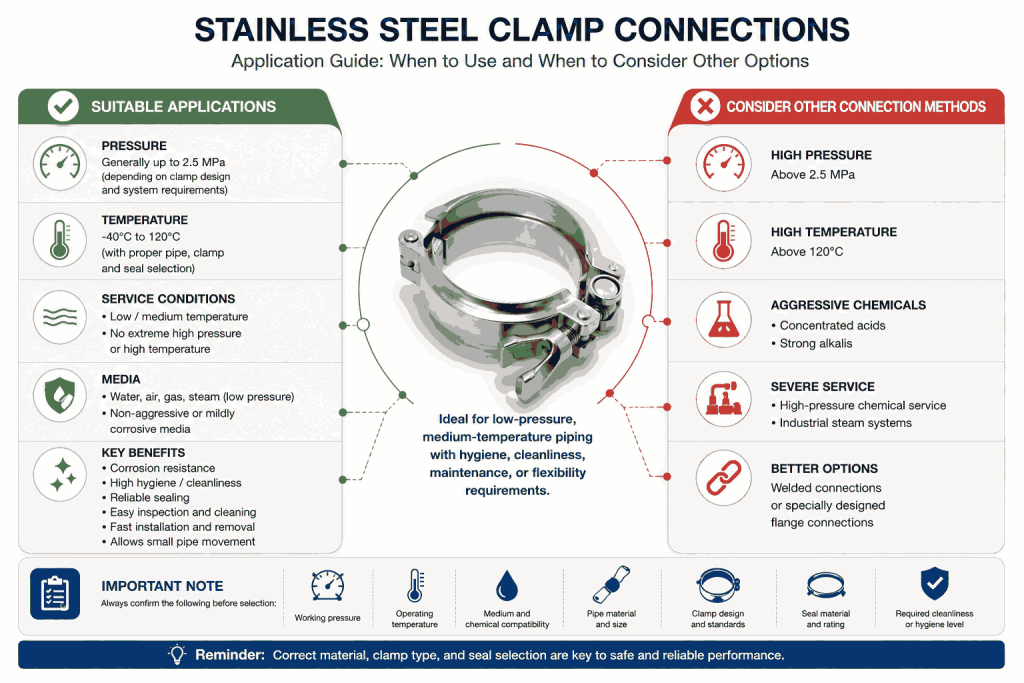
- Pressure generally up to 2.5 MPa, depending on clamp design and system requirements.
- Temperature generally within about -40°C to 120°C, when the pipe, clamp, and seal are correctly selected.
- No extreme high-pressure or high-temperature service.
- No highly aggressive chemical exposure unless the complete connection system has been specifically designed and tested for it.
When Are Clamp Connections Not the Best Choice?
A stainless steel clamp should not be selected only because it is easy to install.
The actual operating conditions must come first.
For systems with:
- Pressure above 2.5 MPa.
- Temperature above 120°C.
- Concentrated acids.
- Strong alkalis.
- High-pressure chemical service.
- Industrial steam service.
a welded connection or specially designed flange connection may be a better option.
The final selection should consider the working pressure, operating temperature, medium, chemical compatibility, pipe dimensions, clamp design, seal material, and required cleanliness level.
Need help selecting the right stainless steel clamp connection for your application? Contact JC Casting for material selection, custom clamp solutions, and a fast quotation based on your drawings or technical requirements.