

What Is 17-4 Stainless Steel? Properties, Strength, Applications & Alternatives Guide
Introduction
17-4 stainless steel is one of the most widely used precipitation-hardening stainless steels in manufacturing today. Engineers and buyers often choose it when they need both high strength and reliable corrosion resistance.
You’ll find this alloy in some of the toughest industries out there: aerospace, oil and gas, marine engineering, food processing, and precision casting.It performs well in parts that face heavy loads, wear, or corrosive conditions.
But what is 17-4 stainless steel,anyway? What does “PH” mean? And how does this material compare with other stainless steels?
In this guide, we’ll walk you through the properties, strengths, limitations, applications, and alternatives of 17-4 PH stainless steel in straightforward, practical language.17-4 PH stainless steel in clear and practical terms.
What Is 17-4 Stainless Steel?
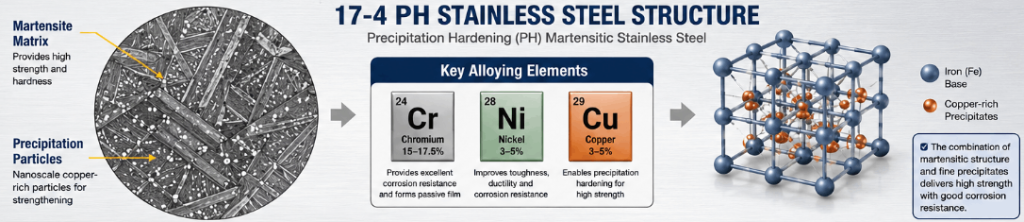
17-4 stainless steel, also called 17-4 PH stainless steel, is a precipitation-hardening martensitic stainless steel.
The name “17-4” comes from its approximate alloy content:
·Around 17% chromium
·Around 4% nickel
Engineers developed this alloy to solve a common problem. Traditional stainless steels often forced designers to choose between corrosion resistance and mechanical strength. 17-4 PH offers both.
After heat treatment, 17-4 can reach very high strength while still resisting corrosion better than many hardened stainless steels.
Its official designations include:
| Standard | Grade |
| UNS | S17400 |
| ASTM | A564 / A693 |
| EN | 1.4542 |
Today, 17-4 PH remains one of the most popular high-strength stainless steels used in industrial components.
What Does “PH” Mean in Stainless Steel?
The letters PH stand for Precipitation Hardening.
Precipitation hardening is a heat-treatment method that increases strength and hardness.
Unlike ordinary stainless steels, 17-4 PH gains strength through controlled aging treatment.
The process works in three basic steps:
1.Solution treatment
2.Cooling
3.Aging heat treatment
During aging, tiny particles form inside the metal structure. These particles block dislocation movement and make the material harder and stronger.
This process gives 17-4 PH an important advantage: high strength without severe distortion.
Because of this, manufacturers often use 17-4 for precision parts with tight tolerances.
Chemical Composition of 17-4 PH Stainless Steel
The performance of 17-4 stainless steel comes from its balanced chemical composition.
17-4 PH Chemical Composition Table
| Element | Content (%) | Function |
| Chromium (Cr) | 15–17.5 | Corrosion resistance |
| Nickel (Ni) | 3–5 | Toughness and strength |
| Copper (Cu) | 3–5 | Precipitation hardening |
| Niobium + Tantalum | 0.15–0.45 | Stabilization |
| Carbon (C) | ≤0.07 | Strength control |
| Manganese (Mn) | ≤1.0 | Deoxidation |
| Silicon (Si) | ≤1.0 | Processing stability |
| Iron (Fe) | Balance | Base structure |
Two elements matter most:
Chromium creates a protective oxide layer that resists corrosion.
Copper supports precipitation hardening and helps create the alloy’s high strength.
Key Properties of 17-4 Stainless Steel
17-4 PH combines several useful properties.
Corrosion Resistance
17-4 offers good corrosion resistance in many industrial environments.
It performs better than:
·410 stainless steel
·420 stainless steel
·Many hardened alloy steels
Its corrosion resistance is often compared with 304 stainless steel, although it may not match 316 in highly aggressive chloride conditions.
Typical resistant environments include:
·Mild chemicals
·Industrial atmospheres
·Fresh water
·Food processing systems
·Moderate marine exposure
However, long-term seawater exposure may require more corrosion-resistant alloys.
Heat Treatment Capability
Heat treatment makes 17-4 unique.
Unlike 304 or 316 stainless steel, 17-4 can be strengthened after machining or casting.
Common aging conditions include:
| Condition | Temperature | Typical Result |
| H900 | 482°C | Highest strength |
| H1025 | 552°C | Balanced strength and toughness |
| H1150 | 621°C | Better toughness and stress relief |
The chosen condition affects final performance.
Lower aging temperatures create higher hardness and strength.
Higher temperatures improve toughness.
Mechanical Properties of 17-4 PH Stainless Steel
One major reason engineers select 17-4 stainless steel is its outstanding mechanical strength.

Mechanical Property Comparison
| Property | 17-4 PH H900 |
| Yield Strength | 1000–1170 MPa |
| Tensile Strength | 1310–1450 MPa |
| Hardness | 38–44 HRC |
| Elongation | 8–12% |
| Density | 7.75 g/cm³ |
These values are much higher than common stainless steels.
For comparison:
| Material | Yield Strength |
| 304 | ~215 MPa |
| 316 | ~290 MPa |
| 17-4 PH | >1000 MPa |
This large strength advantage allows engineers to:
·Reduce wall thickness
·Lower component weight
·Improve load capacity
Advantages of 17-4 Stainless Steel
17-4 PH offers several practical advantages.
1. High Strength
This alloy delivers very high strength after aging treatment.
It supports heavily loaded parts and structural components.
2. Good Corrosion Resistance
It resists many industrial and mildly corrosive environments.
This reduces maintenance and replacement costs.
3. Heat Treatable
Designers can tailor properties through heat treatment.
Different hardness levels support different applications.
4. Good Dimensional Stability
17-4 experiences less distortion than many quenched steels.
This helps maintain tight tolerances.
5. Versatile Manufacturing
The alloy supports:
·Precision casting
·Machining
·Forging
·Welding
This makes it suitable for many production routes.
Limitations of 17-4 PH Stainless Steel
No material is perfect.
17-4 stainless steel also has limitations.
Limited Chloride Resistance
Although corrosion resistance is good, it is not ideal for severe chloride or seawater environments.
Pitting may occur under aggressive conditions.
Reduced Toughness at Highest Strength
H900 treatment produces maximum strength, but toughness decreases.
Engineers must balance strength and ductility.
Welding Needs Careful Control
Welding is possible, but poor procedure may reduce properties.
Post-weld aging often becomes necessary.
Higher Cost Than Standard Stainless Steel
17-4 usually costs more than:
·304
·316
·410
The higher alloy content and heat treatment increase total cost.
Machining and Welding Performance
17-4 PH machines reasonably well.
In solution-treated condition, machining is easier.
After aging, hardness rises and machining becomes more difficult.
Recommended machining practices include:
·Sharp tooling
·Lower cutting speeds
·Good coolant supply
Welding
17-4 supports welding through methods such as:
·TIG
·MIG
·Resistance welding
However, welding may affect heat-treated properties.
Manufacturers often perform:
·Post-weld heat treatment
·Controlled aging
to restore performance.
Common Applications of 17-4 Stainless Steel
17-4 PH appears in many industries.

Aerospace
Used for:Structural brackets;Landing gear components;Fasteners
Oil and Gas
Used in:Valve parts;Pump shafts;Pressure equipment
Marine Industry
Applied in:Propeller shafts;Offshore hardware;Corrosion-resistant components
Food Processing
Used for:Equipment fittings;Mixing parts;Sanitary systems
Precision Casting
17-4 PH is widely used in:Investment cast valves;Pump bodies;Complex precision components
Its strength and dimensional stability support precision casting applications.
17-4 PH vs Other Stainless Steels
Many buyers compare 17-4 with common stainless grades.
17-4 PH vs 304 Stainless Steel
| Property | 17-4 PH | 304 |
| Strength | Much Higher | Moderate |
| Heat Treatable | Yes | No |
| Corrosion Resistance | Good | Very Good |
| Cost | Higher | Lower |
304 works well for general corrosion resistance.
17-4 works better where strength matters.
17-4 PH vs 316 Stainless Steel
316 offers stronger chloride resistance.
17-4 offers much higher strength.
For marine chloride environments:
·316 may resist corrosion better
·17-4 handles load better
Selection depends on service conditions.
What Can Replace 17-4 Stainless Steel?
Several materials may replace 17-4 depending on application needs.
15-5 PH
Good alternative when higher toughness is needed.
316 Stainless Steel
Suitable when corrosion matters more than strength.
Duplex Stainless Steel
Useful in chloride-rich environments.
Examples include:
·Duplex 2205
·Super Duplex 2507
These alloys offer stronger corrosion resistance.
Nickel Alloys
For extreme chemical environments:
·Alloy 625
·Hastelloy grades
These provide superior corrosion resistance but cost much more.
How to Choose the Right Material
Material selection should not focus on strength alone.
Engineers should evaluate:
·Corrosion environment
·Load conditions
·Heat exposure
·Manufacturing route
·Lifecycle cost
A stronger material does not always create a better design.
Sometimes corrosion risk or fabrication limits matter more.
17-4 PH works best when projects require:
·High strength
·Moderate corrosion resistance
·Heat-treatment flexibility
·Precision manufacturing
JC CASTING Material Selection & Casting Guidance
At JC CASTING, we view material selection as more than choosing a metal grade. Successful components depend on matching alloy performance, casting capability, and real operating conditions.
17-4 PH stainless steel offers excellent potential, but achieving stable performance requires proper control of:
·Chemical composition
·Heat treatment
·Casting quality
·Machining and inspection standards
Our engineering team supports customers with:
·17-4 PH material selection advice
·Precision investment casting development
·Heat-treatment coordination
·DFM and manufacturability evaluation
Prototype and mass production support for complex stainless steel parts
Whether you are developing valve components, pump systems, marine hardware, or high-strength industrial castings, JC CASTING can help you pick the most practical and cost-efficient material solution for your project.